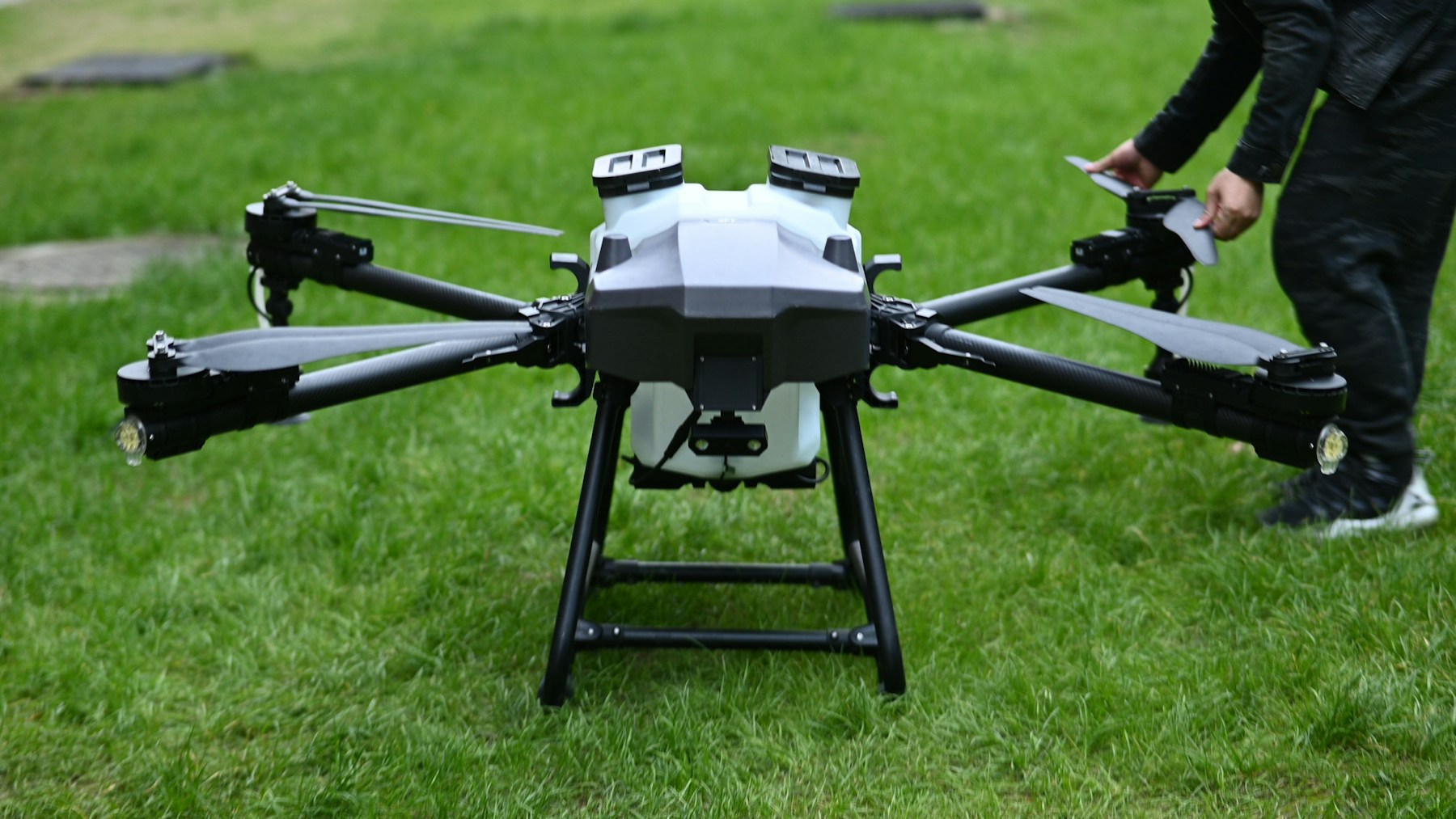
The future of drone technology is less about new aircraft and more about drones flying routinely without a pilot on site: automated docks, flights beyond visual line of sight (BVLOS), AI that turns images into findings, and digital airspace systems that let many drones share the sky safely. The rules are catching up. In the EU, the U-space framework for managing drone traffic took effect on 26 January 2023, and in the US the FAA proposed a dedicated BVLOS rule, Part 108, in August 2025 and sent the final version for White House review in July 2026. At the same time, security and supply-chain politics, such as the US moves against foreign-made drones, are reshaping which drones companies buy.
This guide covers the trends that matter most for businesses using drones, what is already in use and what is still coming.
Table of contents
Drone technology trends at a glance
| Trend | Status in 2026 | What it changes |
|---|---|---|
| BVLOS operations | Authorised case by case in the EU; US Part 108 rule awaiting final publication | Long inspections, deliveries and patrols without a pilot following the drone |
| Drone docks | Commercially available and in use | Scheduled flights launched remotely, with automatic charging |
| AI analysis | Widely used for detection and measurement | Faster findings from inspection and survey data |
| U-space | Framework in force since 2023; airspaces being designated | Many drones sharing low-level airspace safely |
| Remote ID | Required in the EU and US | Drones can be identified in flight |
| Counter-drone security | Growing quickly, new EU action plan in 2026 | Protection of airports, events and critical sites |
| Supply-chain rules | US restrictions on foreign-made drones | Changes in which drones organisations can buy |
BVLOS becomes routine
Most of the value of drones in infrastructure comes from covering long distances: power lines, pipelines, railways and roads. That needs flights beyond the pilot's visual line of sight. In the EU, BVLOS flights are possible today in the specific category with an operational authorisation, usually based on a SORA risk assessment. In the US, the FAA's proposed Part 108 would create standard rules for BVLOS operations; the FAA has said it hopes to publish the final rule before the end of 2026.
Long-range BVLOS is already being used at scale: Deutsche Bahn, for example, announced plans to use long-range drones to check railway lines for storm damage. See our guides to drone railway inspection and powerline inspection.
Drone docks and remote operations
A drone dock is a weatherproof box that stores, charges and launches a drone. Combined with BVLOS approval, docks let operators fly scheduled inspections, security patrols or emergency response flights from a remote operations centre. Our guide to BVLOS with DJI Dock explains how it works, and drone as first responder programmes use the same idea for emergency services.
AI and automated analysis
Drones collect far more images than people can review. AI now detects defects such as cracks, corrosion and hot spots, counts objects, measures stockpiles and compares surveys over time. The pilot's job is shifting to planning missions and checking results, while software does the first pass of analysis. People still make the final call on safety-critical findings. See our guide to drone data processing and digital twins.
U-space and digital airspace
U-space is the EU's system for managing drone traffic at low altitude. Under Regulation (EU) 2021/664, countries designate U-space airspace where drones must use digital services for flight authorisation, traffic information and Remote ID. In Finland, Fintraffic's services already let operators share flight plans and see other air traffic; Flyby Guys announces its flights in Fintraffic Sky, which also shows aircraft such as rescue helicopters. Read more in our guide to EU drone regulations.
Better sensors in smaller packages
LiDAR. Survey-grade scanners now fit on mid-sized drones. See our guide to photogrammetry vs LiDAR.
Thermal. Radiometric thermal cameras are standard on enterprise drones for solar, roof and electrical inspections.
Multispectral. Crop and vegetation health for agriculture and environmental monitoring. See RGB vs multispectral sensors.
Heavier payloads. Cargo drones now carry tens of kilograms. See our guide to heavy lift drones.
Security, counter-drone and supply chains
Counter-drone systems. Airports, prisons, events and critical infrastructure are investing in detection and response. The European Commission published a drone and counter-drone security action plan on 11 February 2026. See our guide to counter-drone systems.
Remote ID. Drones broadcast their identity and position, which helps authorities tell legitimate flights from rogue ones.
Supply chains. In the US, restrictions on foreign-made drones affect DJI and others. See our guide to the US foreign drone ban.
Future drone applications by industry
| Industry | Today | Next |
|---|---|---|
| Energy and utilities | Thermal and visual inspections of lines, solar and wind | Dock-based BVLOS patrols and automated defect reports |
| Construction | Progress mapping and site surveys | Daily automated scans compared with the design model |
| Telecom | Tower inspections and 3D models | Remote audits and faster disaster recovery |
| Public safety | Search and rescue, incident overview | Drones launched automatically on emergency calls |
| Logistics | Trials and niche routes | Regular deliveries in designated U-space airspace |
| Events | Drone light shows | Larger, more complex shows and branded content |
For examples, see our guides to drones in construction, drones for search and rescue and drone light shows.
Frequently asked questions
What is the future of drone technology?
Routine automated flights: drones in docks flying BVLOS missions, AI analysing the data, and digital airspace systems managing traffic, under clearer rules in the EU and US.
What are the biggest drone trends in 2026?
BVLOS rules, drone docks, AI analysis, U-space, Remote ID, counter-drone security and restrictions on foreign-made drones in the US.
Will drones fly without pilots?
Drones already fly automated missions, but a remote pilot remains responsible. Future rules allow one pilot to supervise several drones from a remote location in some cases.
When will the FAA BVLOS rule take effect?
The FAA proposed Part 108 in August 2025 and sent the final rule for White House review in July 2026. The FAA hopes to publish it before the end of 2026, and it will set its own effective date.
What is U-space?
The EU framework for managing drone traffic in designated low-level airspace, in force since 26 January 2023.


