Heavy lift drones are drones built to carry payloads of roughly 15 kg and up, from large survey sensors to cargo of 100 kg or more. Today's production models include the DJI FlyCart 30, which carries up to 40 kg, and the DJI FlyCart 100, which carries up to 85 kg in normal operation. The trade-off is short flight time with a full load, often 15 minutes or less, and stricter rules: in the EU, drones of 25 kg or more cannot fly in the open category.
This guide compares current heavy lift drones on published specifications, explains what they are used for, and covers the rules and practical limits that decide whether one is right for your job.
Table of contents
What counts as a heavy lift drone
There is no official definition. In practice, the term covers drones whose main job is carrying weight rather than a small camera. They fall into three broad groups:
| Group | Typical payload | Examples of use |
|---|---|---|
| Heavy sensor carriers | Around 5 to 20 kg | Cinema cameras, LiDAR scanners, large inspection payloads |
| Cargo drones | Around 20 to 100 kg | Moving materials to remote sites, mountain logistics, emergency supplies |
| Very heavy lift | 100 kg and above | Utility construction, specialist industrial lifting, often custom or low-volume aircraft |
Heavy lift drones compared
All figures are manufacturers' published specifications. Flight time and range fall sharply as payload rises.
| Model | Max payload | Flight time or range at heavy load | Weather protection |
|---|---|---|---|
| DJI FlyCart 100 | 85 kg (dual battery); 100 kg single battery, emergency use only | Up to 12 km or about 14 minutes at near maximum takeoff weight | IP55, 12 m/s wind, -20°C to 40°C |
| DJI FlyCart 30 | 30 kg (dual battery); 40 kg (single battery) | Up to 16 km with full payload, dual battery | IP55, 12 m/s wind, -20°C to 45°C |
| Freefly Alta X | About 16 kg | About 22 minutes with a 10 kg camera; 50 minutes without payload | Check with manufacturer |
| GRIFF Aviation 300 | About 225 kg | Around 30 to 45 minutes, depending on load | Built to order; check with manufacturer |
The FlyCart models are mass-produced cargo drones with winch options for lowering loads without landing. The Alta X is a sensor carrier, popular for heavy cameras and LiDAR. Aircraft in the GRIFF class are specialist, low-volume machines, usually supplied for specific industrial projects.
What heavy lift drones are used for
Construction and utilities. Carrying tools, cables and components to towers, power lines and sites without road access, instead of using a helicopter or crane.
Mountain and remote logistics. Supplying huts, research stations and work sites where access is slow or seasonal.
Emergency response. Delivering supplies, rescue equipment or communications kit to areas cut off by floods, fires or landslides.
Heavy sensors. Flying cinema cameras for film and broadcast, or survey-grade LiDAR for mapping. See our guide to LiDAR drones for surveying.
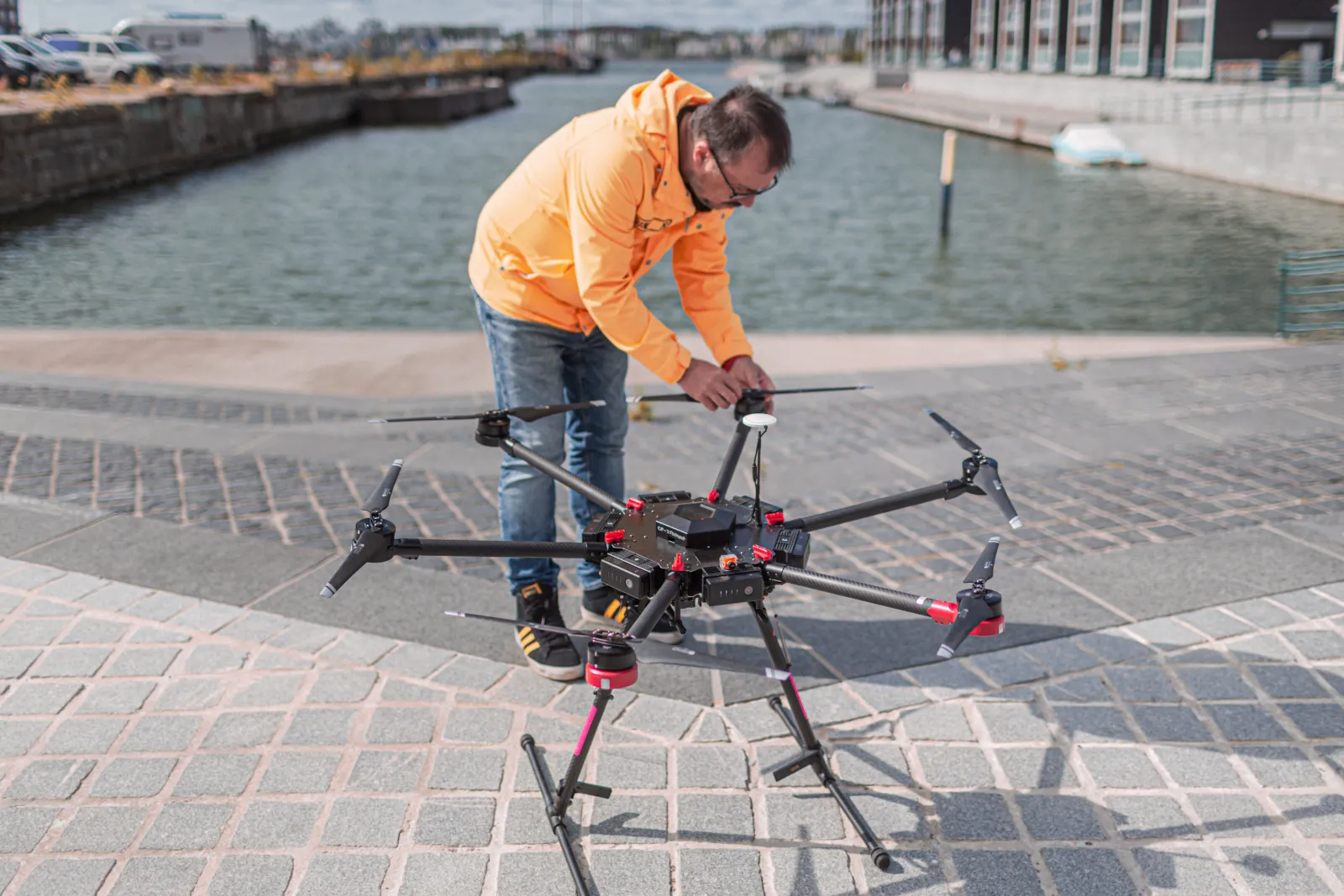
Delivery. Lighter delivery drones carry a few kilograms over longer distances. Flyby Guys led BVLOS pharmacy delivery trials in Helsinki using a DJI M600, which carries up to 5 kg. Heavy lift drones extend that to bulky or heavy cargo over shorter hops. Our guide to drone food delivery covers the lighter end of the market.
Payload vs flight time
Battery-powered drones trade payload for endurance. Every extra kilogram means more power to stay airborne, and the batteries themselves are heavy. That is why the FlyCart 100's flight time at near maximum weight is measured in minutes, and why manufacturers often quote a higher payload with one battery than with two.
For most heavy lift work, this means short, repeated hops rather than long flights: lift, deliver, return, swap batteries. Plan jobs around the realistic loaded range, not the empty-aircraft figures, and allow a reserve for wind and cold. Our guide to drone weather limits explains why cold weather cuts battery performance further.
Rules for heavy lift drones
Weight is one of the main factors in drone regulation, so heavy lift drones almost always need more than a basic licence.
EU. The open category is limited to drones under 25 kg. Heavier drones, and most cargo operations, fall into the specific category and need an operational authorisation from the national aviation authority, usually based on a SORA risk assessment. Carrying loads over people, or dropping or lowering cargo, adds further conditions.
UK. Drones of 25 kg or more also fall outside the open category and need an operational authorisation from the CAA.
US. Part 107 covers drones under 55 lb (about 25 kg) at take-off. Heavier drones need additional FAA approval, such as an exemption. Foreign-made drones of 25 kg or more are also one of the categories in a July 2026 FCC proposal that would stop their sale in the US; see our guide to the US foreign drone ban.
Operations beyond visual line of sight, which many cargo routes need, require a separate authorisation. Our guide to BVLOS operations covers the process. Always check airspace restrictions along the whole route with our no-fly zone guide.
Limitations
Short endurance. Full-load flight times are short, so long routes need relays or landing points.
Risk on the ground. A heavy aircraft with a heavy load carries more energy if something goes wrong, which is why rules and buffers are stricter.
Logistics. Large drones need vehicles to move them, plenty of batteries, chargers and often generators on site.
Load handling. Swinging loads on a winch or sling affect stability and need trained crews and careful procedures.
Weather. Wind limits apply to the loaded aircraft, and a large load adds drag.
Maintenance. Heavy loads wear motors and frames faster. See our drone maintenance checklist.
How to choose a heavy lift drone
Start with the load. Weigh the heaviest item you need to move, including slings, boxes or mounts, and add a margin.
Check loaded range, not empty range. Compare the distance or flight time each model achieves with your actual load.
Decide how loads are delivered. Landing, winching or releasing a load each needs different equipment and procedures.
Check the rules for your operation. Confirm which category the drone and mission fall into, and how long an authorisation will take.
Plan the support kit. Batteries, charging, transport, spare parts and crew training are a large part of the real cost.
Consider a service provider. For occasional lifts, hiring an experienced operator with the right authorisation is often faster and cheaper than building the capability in-house.
Frequently asked questions
How much weight can a drone carry?
It depends on the drone. Consumer camera drones carry almost nothing beyond their own camera. Heavy lift cargo drones such as the DJI FlyCart 30 carry up to 40 kg, the FlyCart 100 up to 85 kg in normal use, and specialist aircraft can carry over 200 kg.
What is the heaviest payload drone you can buy?
Among mass-produced models, the DJI FlyCart 100 is one of the highest, at 85 kg in dual-battery mode. Specialist aircraft such as the GRIFF 300 carry more, but are built to order.
How long can a heavy lift drone fly?
With a full load, often around 15 minutes or less. Flight time increases as the payload gets lighter.
Do you need a licence to fly a heavy lift drone?
Yes. In the EU and UK, drones of 25 kg or more need an operational authorisation in the specific category. In the US, drones of 55 lb or more need approval beyond Part 107.
What are heavy lift drones used for?
Mainly moving materials to remote or hard-to-reach sites, carrying heavy cameras and survey sensors, emergency supply drops and specialist utility and construction work.


