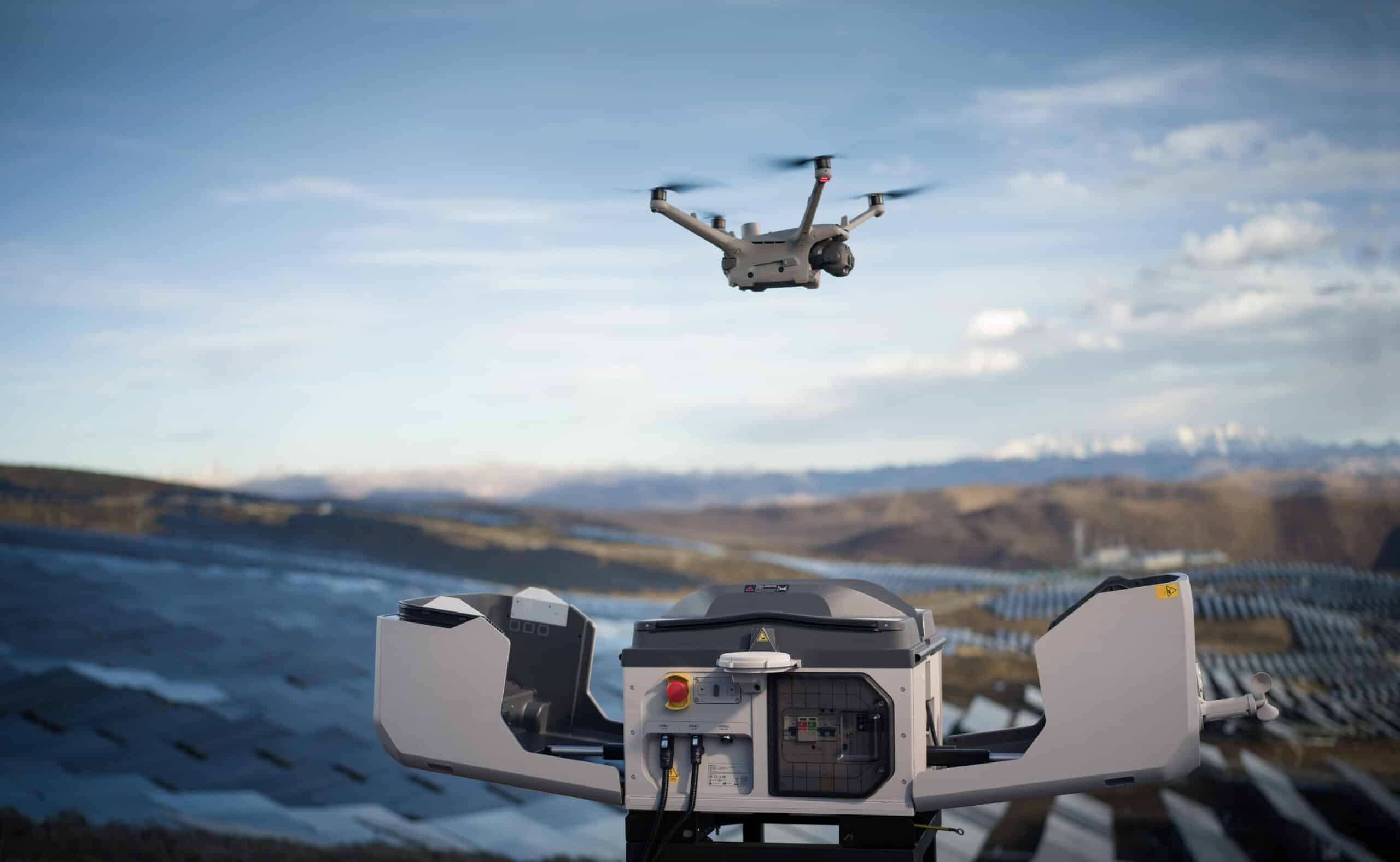
A drone dock is a weatherproof box that stores, charges and launches a drone, so flights can be started remotely or on a schedule and flown beyond visual line of sight (BVLOS) from an operations centre, with no pilot on site. DJI's current model, the Dock 3, launched in 2025 for the Matrice 4D and 4TD. It is rated IP56, works from -30°C to 50°C with preheating, recharges the drone from 15% to 95% in about 27 minutes, and can be mounted on a vehicle. The hardware is the easy part: routine dock operations need BVLOS approval, which in the EU means the specific category and an operational authorisation.
This guide covers how dock operations work, Dock 3 specifications, uses, remote operations, the rules in the EU and the US, and how to plan a deployment.
Table of contents
How drone-in-a-box operations work
The dock is installed on site. On a roof, mast or ground pad, or on a vehicle, with power and a network connection.
A mission is triggered. On a schedule, by an alarm or sensor, or by an operator in a remote operations centre.
The drone launches automatically. It flies a planned route or is directed live, while a remote pilot monitors the flight.
Data streams and uploads. Live video goes to the operations centre, and images upload to the cloud for processing.
The drone lands and recharges. The dock closes, charges the drone and is ready for the next mission.
DJI Dock 3 at a glance
| Specification | DJI Dock 3 with Matrice 4D series |
|---|---|
| Compatible drones | Matrice 4D and Matrice 4TD (thermal) |
| Protection | Dock IP56, drone IP55 |
| Operating temperature | -30°C to 50°C with preheating |
| Charging | About 27 minutes from 15% to 95% |
| Flight time | Up to 54 minutes (manufacturer figure) |
| Transmission range | Up to 12 km under CE rules, 25 km under FCC rules |
| Wind resistance | 12 m/s for operation and landing |
| Mounting | Fixed or vehicle-mounted |
Manufacturer figures are best case; plan routes on realistic flight times and ranges for your weather and payload.
What docks are used for
Security patrols. Scheduled and alarm-triggered flights over large sites. See our guide to construction site security with drones.
Infrastructure inspections. Repeated inspections of substations, solar plants, pipelines and power lines. See powerline inspection and drone solar panel inspection.
Construction progress. Automated mapping flights on a fixed schedule. See drones in construction.
Emergency response. Drones launched to incidents before responders arrive. See drone as first responder.
Mining and industrial sites. Stockpile surveys and safety checks. See drones for mining.
Remote operations
Dock operations are run from a remote operations centre through cloud software such as DJI FlightHub 2, which plans missions, shows live video and manages data. A remote pilot remains responsible for each flight and must be able to intervene. Reliable connectivity at the dock and along the route is essential, and procedures must cover lost links, bad weather and people entering the area. See our guides to drone operations management platforms and drone live streaming.
BVLOS rules for dock operations
EU. Routine dock operations are BVLOS, so they fall in the specific category and need an operational authorisation, usually based on a SORA risk assessment. Expect to show how the drone stays within its operational volume, how other air traffic is detected and how ground risk is controlled. In Finland, Flyby Guys announces its flights in Fintraffic Sky, which also shows other air traffic such as rescue helicopters. See our guide to EU drone regulations.
US. BVLOS currently needs FAA waivers or exemptions; the FAA proposed a dedicated BVLOS rule, Part 108, in August 2025. US buyers should also check the status of restrictions on foreign-made drones. See our guides to the US foreign drone ban and the future of drone technology.
Airspace. Check every route against restricted zones. See our no-fly zone guide.
Planning a dock deployment
Define the missions. What to inspect or patrol, how often, and what data is needed.
Choose the site. Power, network, a clear take-off area, security and protection from snow and debris.
Plan routes. Within realistic range, away from people where possible, and inside approved airspace.
Get authorisation. Prepare the risk assessment, procedures and training for the remote pilots.
Test and expand. Start with supervised flights, then move to routine remote operations.
Maintain. Regular checks of the dock, drone and batteries. See our drone maintenance checklist.
Limitations
Weather. Wind, icing and heavy snow limit flights. See our guide to drone weather limits.
Authorisation time. BVLOS approvals take planning and evidence.
Connectivity. Remote sites may need extra network infrastructure.
Range. One dock covers a limited area; larger networks need several docks.
Frequently asked questions
What is a drone-in-a-box?
A dock that stores, charges and launches a drone automatically, so missions can be run remotely or on a schedule.
What drones work with DJI Dock 3?
The Matrice 4D and Matrice 4TD, the thermal version.
Do dock operations need BVLOS approval?
Usually. Routine remote flights are beyond visual line of sight, which in the EU requires the specific category and an operational authorisation.
Can DJI Dock 3 work in winter?
DJI rates it for -30°C to 50°C with preheating, but wind, icing and snow still limit flights.
Can a dock be mounted on a vehicle?
Yes. DJI Dock 3 can be mounted on a vehicle and deployed on the move.


