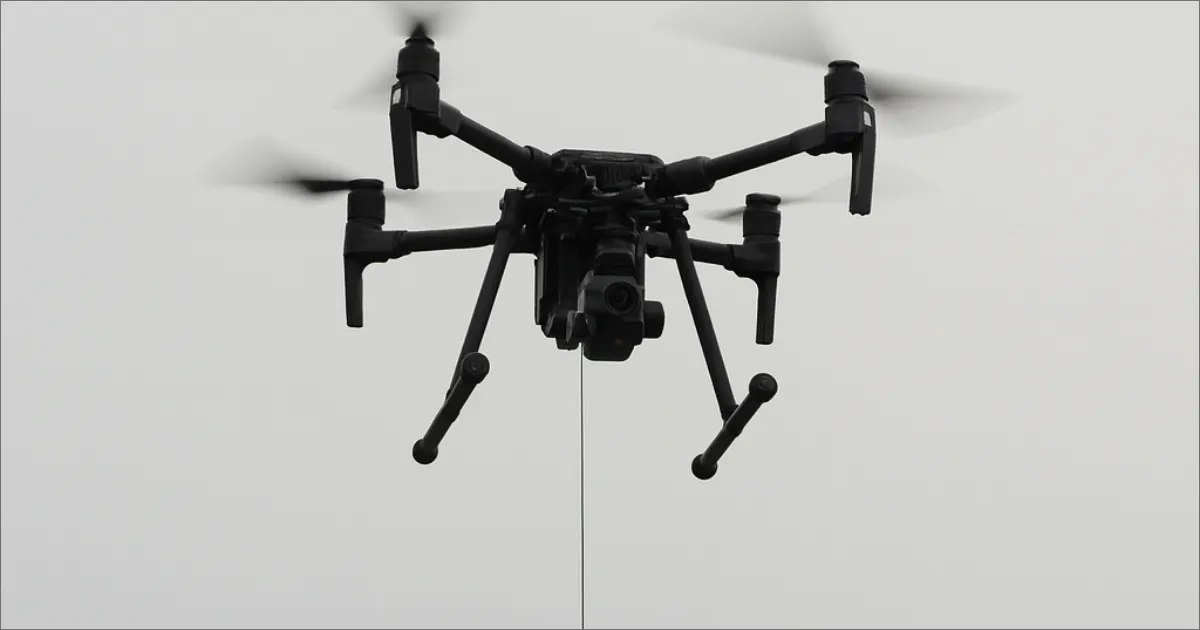
A tethered drone is a drone connected to a ground station by a cable that supplies power and, usually, a secure data link. Because it never runs out of battery, it can stay in the air for hours or days instead of 30 to 50 minutes. The trade-off is that it stays over one spot, within the length of its tether, typically up to about 100 m. That makes tethered drones ideal for persistent surveillance, temporary communications masts and event or incident overwatch, and a poor fit for anything that needs to travel.
This guide explains how tethered drone systems work, where they are used, how they compare with free-flying drones, and how the rules treat them in the EU, the UK and the US.
Table of contents
How a tethered drone system works
A tethered system has four main parts:
The drone. Usually a multirotor carrying a camera, thermal sensor, radio relay or other payload. It often has a small backup battery so it can land safely if ground power fails.
The tether. A strong, light cable, often reinforced with materials such as Kevlar, carrying electrical power up to the drone. Many tethers also carry data over copper or optical fibre, which gives a link that is hard to jam or intercept.
The ground station and winch. The ground unit converts power from a generator, vehicle or mains supply, and an automatic winch keeps the tether at the right tension as the drone climbs, descends or moves in the wind.
The control system. Many tethered systems fly largely automatically: the operator sets a height and the drone holds position above the ground station, which can be fixed or mounted on a vehicle or vessel.
Elistair's Orion system, for example, uses a 100 m Kevlar tether, is rated for 50 hours of flight, and is rated for average wind of 35 km/h with gusts up to 50 km/h.
Tethered vs free-flying drones
| Tethered drone | Free-flying drone | |
|---|---|---|
| Endurance | Hours to days, limited by ground power and maintenance | Typically 30 to 50 minutes per battery |
| Coverage | One fixed point, within tether length | Can travel kilometres |
| Data link | Wired link possible, hard to jam or intercept | Radio link that can suffer interference |
| Operator workload | Low once deployed, largely automatic | Pilot actively flying, battery swaps |
| Fly-away risk | Very low, physically attached | Depends on systems and procedures |
| Set-up | Ground station, power source and tether | Quick launch from a case or backpack |
In short: choose a tethered drone when you need to watch one place for a long time, and a free-flying drone when you need to cover ground.
What tethered drones are used for
Persistent surveillance. A camera held at height over a site, border, port or perimeter for a full shift or longer. See our guide to site security with drones.
Event and crowd overwatch. A fixed aerial view over a festival, stadium or public gathering for the security control room. Our guide to drones for crowd control covers how this is used.
Incident command. Fire and rescue services use tethered drones to give the incident commander a continuous view of a fire or accident scene.
Temporary communications. Lifting a radio relay or mobile network antenna to restore coverage after a disaster or at a remote site, acting as a temporary mast.
Infrastructure and industrial sites. Monitoring construction sites, energy facilities and ports during sensitive operations.
Maritime. Tethered to a vessel to extend the crew's view to the horizon.
Tethered drones in military and security work
Militaries use tethered drones as raised observation points for bases, convoys and checkpoints. The long endurance and wired data link suit continuous intelligence, surveillance and reconnaissance, where a free-flying drone would need frequent battery swaps and a radio link that can be jammed. Our guide to ISR in the military explains where tethered systems fit alongside other platforms.
Tethered drones can also host sensors that detect other drones, giving a higher vantage point for counter-drone systems than ground-based sensors alone.
Limitations
Fixed position. The drone cannot follow a moving target beyond its tether, unless the ground station is on a moving vehicle.
Limited height. Tether length and local rules cap the height, typically well under the altitude a free-flying drone could reach.
Weather. The tether adds drag, and strong wind still grounds the system. See our guide to drone weather limits.
Ground footprint. The ground station needs power, space and protection, and the tether creates a hazard area around it.
Maintenance. Long flights wear motors faster. Continuous operation still needs planned stops for inspection.
Rules for tethered drones
Being tethered does not take a drone outside aviation rules, but it can make approval easier.
EU. Tethered drones are covered by the same EU drone regulations as other drones. The EU's drone product rules (Delegated Regulation 2019/945) include specific provisions for tethered drones in some classes, including a tether of less than 50 m and a breaking strength of at least ten times the drone's maximum mass. In the specific category, a tether is a recognised way to reduce risk in a SORA assessment, because it limits where the drone can go. See our guide to SORA.
UK. According to the CAA, tethered drones over 1 kg are subject to the same rules as other drones, while those of 1 kg or less are covered separately by article 265E of the Air Navigation Order. The CAA notes that a tether can be "a significant risk mitigation" when applying for an operational authorisation.
US. The FAA Reauthorization Act of 2024 created a route for public safety organisations, including volunteers, to fly actively tethered drones at or below 150 ft without a Part 107 certificate, provided the tether stays taut, the drone stays in sight and gives way to manned aircraft, and it is not flown directly over people not involved in the operation. Other users fly under the normal Part 107 rules.
Airspace restrictions still apply to tethered flights. Check them as you would for any flight, using our no-fly zone guide.
Choosing a tethered drone system
Tether length and working height. Match them to the view you need and the height your rules allow.
Payload. Check which cameras, thermal sensors or radio payloads the system supports, and their weight.
Power source. Generator, vehicle or mains, and how long each can run.
Data link. Whether data runs over the tether, and whether fibre is available for secure, high-bandwidth video.
Wind and weather rating. The published wind limit and IP rating for the drone and ground station.
Mobility. Whether the ground station can be mounted on a vehicle or vessel.
Failsafes. What happens if ground power fails or the tether breaks: backup battery, automatic landing and how quickly it reacts.
Frequently asked questions
What is a tethered drone?
A drone connected to a ground station by a cable that supplies power and often data, so it can stay airborne for hours or days over one location.
How long can a tethered drone fly?
As long as it has ground power and the hardware holds up. Systems are commonly rated for many hours of continuous flight. Elistair's Orion, for example, is rated for 50 hours.
How high can a tethered drone fly?
Up to the length of its tether and the height the local rules allow. Tethers of around 100 m are common for surveillance systems.
Do you need a licence to fly a tethered drone?
Usually the same requirements apply as for any other drone of that size and use. In the US, public safety organisations can fly actively tethered drones at or below 150 ft without a Part 107 certificate under the 2024 FAA Reauthorization Act.
What are tethered drones used for in the military?
Mainly persistent surveillance and reconnaissance over bases, convoys and checkpoints, plus communications relay and raised sensor positions for detecting other drones.


