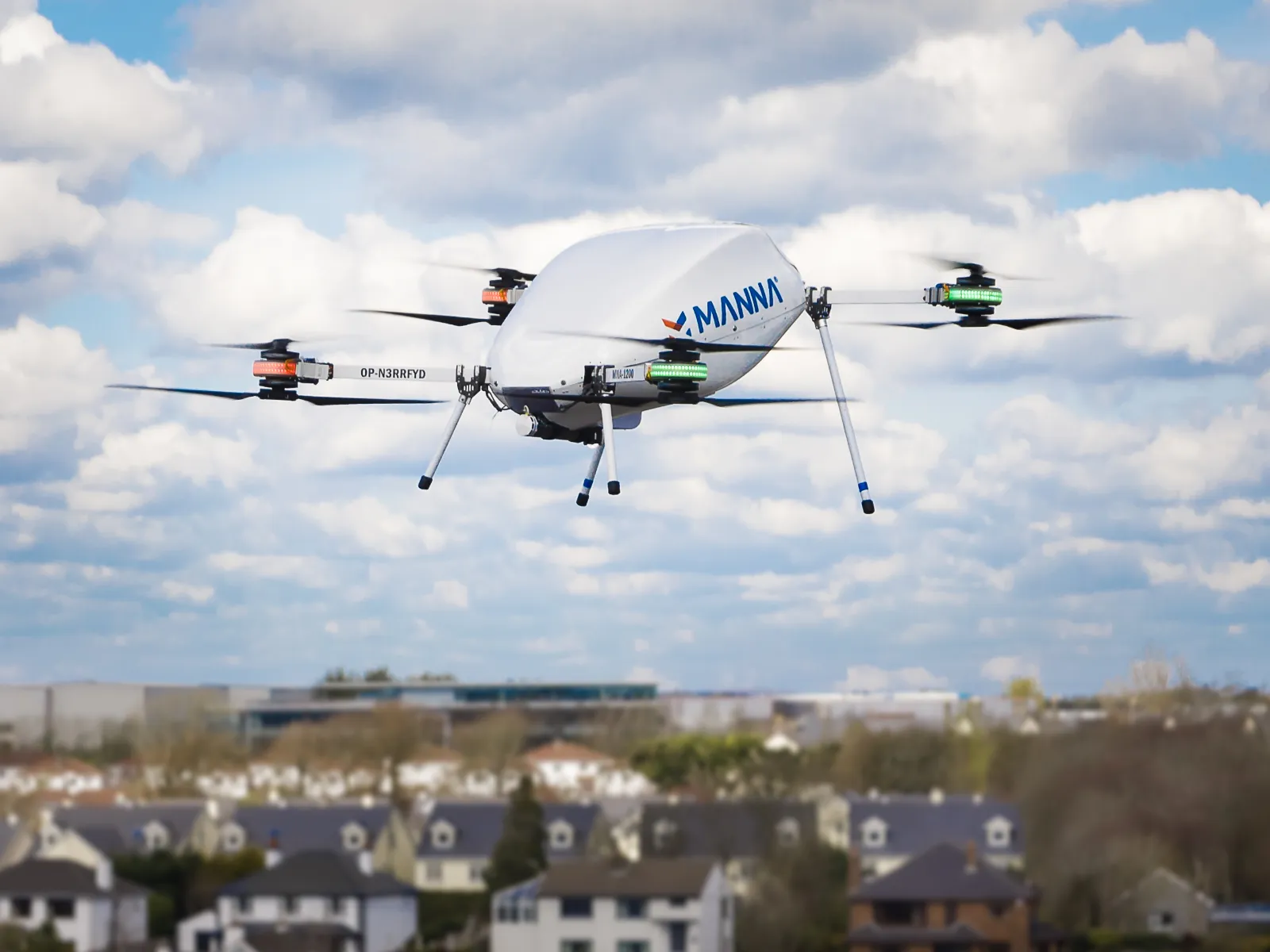
Drone food delivery is now a real, if still small, service in parts of the US and Europe. In the US, Wing delivers from Walmart stores and is expanding to more than 270 of them, and Uber and Zipline announced in August 2026 that they aim to reach one million Uber Eats drone deliveries a day by the end of 2029. In Europe, Manna flies food orders for Wolt in Espoo, Finland. Most services lower orders of around 2 kg on a tether within a few kilometres of a hub, and fall back to a courier when the weather turns.
Flyby Guys has worked on both sides of this: we mapped the Espoo delivery area for Manna, and led BVLOS pharmacy delivery trials in Helsinki. This guide covers who delivers where, how a drone delivery actually works, the rules and the real limits.
Table of contents
Who delivers food by drone in 2026
| Company | Where | Partners and status |
|---|---|---|
| Wing (Alphabet) | US, including Dallas-Fort Worth, Atlanta and Houston, with Los Angeles, Miami and others being added | Expanding with Walmart to more than 270 stores, covering about 10% of the US population; also partners with DoorDash |
| Zipline | US and three other continents | More than 2.7 million deliveries to date; Uber Eats deliveries start in Zipline markets later in 2026 |
| Manna | Espoo, Finland; Dallas-Fort Worth, US | Delivers for Wolt in Espoo; more than 50,000 deliveries in Dublin before pausing service in Ireland in 2026; expanding in the US |
The pattern is clear: drone delivery is growing fastest in US suburbs with large retail partners, while Europe has smaller services built around a single hub and a food or grocery partner.
How drone food delivery works
Most current services follow the same basic steps. In Espoo, according to TechCrunch's account of the Manna and Wolt service:
The customer orders as normal. In the Wolt app, the order is sent by drone if one is available.
The food reaches the launch site. In Espoo, couriers bring orders from the kitchen to Manna's launch pad in heat bags.
The order is weighed and sealed. Staff check the weight, balance it if needed, and seal it in an approved bag. Each drone carries about 2 kg.
The flight is planned and monitored remotely. Manna's mission control in Ireland checks the route against detailed maps and sets a drop point close to the customer.
The drone lowers the order. It does not land. Before release, it photographs the drop spot for a human to confirm, then lowers the bag on a biodegradable line.
Bad weather means a courier. If conditions are not suitable, the order goes by road instead.
Wing and Zipline also lower deliveries on a tether rather than landing in gardens or on doorsteps.
Behind the scenes: preparing Espoo for drone delivery
Before Manna could fly in Espoo, it needed precise, up-to-date maps of the area to plan safe routes. Flyby Guys produced a high-resolution orthomosaic map covering a 3.3 km radius of the city in three weeks, including mission planning, permit applications and daily flights across multiple locations. Manna co-founder and CEO Bobby Healy said the data gave Manna what it needed "to safely expand our drone delivery services into Espoo". Read the full Manna case study, or our guide to orthomosaic maps.
This preparation is a large part of any delivery service: accurate maps, obstacle data, agreed landing and drop zones, and approvals for every area the drones will fly over.
Rules for drone delivery in the EU and US
EU. Delivery flights fly beyond the pilot's line of sight, often over towns, so they fall into the specific category. Operators need an operational authorisation from the national aviation authority, usually based on a SORA risk assessment, and must respect local no-fly zones. In Finland the authority is Traficom.
US. Delivery companies currently fly under FAA waivers and exemptions. The FAA proposed Part 108, a standing rule for flights beyond visual line of sight, in August 2025. As of September 2026, the final rule was still under review, with the FAA hoping to publish before the end of the year.
Local planning rules. Aviation approval is not always enough. Manna stopped delivering in Ireland in 2026, citing a lack of planning regulations for drone delivery hubs.
For more on how beyond-visual-line-of-sight operations are approved and run, see our guide to BVLOS operations.
Limits and challenges
Small orders. Delivery drones typically carry around 2 to 3 kg, enough for a meal or a few grocery items but not a family shop. Bigger loads need much larger aircraft, as our guide to heavy lift drones explains.
Short range. Services usually cover a few kilometres around a hub, so coverage depends on how many hubs an operator builds.
Weather. Strong wind, heavy rain and especially icing ground delivery drones. In Finland, icing is the main winter problem, and orders switch to couriers. See our guide to drone weather limits.
Where the drone can deliver. Customers need a clear spot for the drop, which is easier with a garden than in a dense apartment block.
Noise and acceptance. Regular flights over homes raise questions about noise and privacy, and local acceptance can decide whether a service grows.
Is drone delivery cheaper?
Potentially, once services run at scale. Huuva, the Finnish food company working with Manna and Wolt, estimates that a regular delivery costs about €5 to €6, while a drone delivery could fall to about €1, not counting the cost of setting up the service. The economics depend on volume: hubs, aircraft, staff and approvals are expensive, so services need many deliveries a day to pay off.
Frequently asked questions
Is drone food delivery available yet?
Yes, in selected areas. In the US, Wing, Zipline and others deliver around specific stores and hubs. In Finland, Manna delivers Wolt orders in parts of Espoo.
How reliable is drone food delivery compared with a courier?
In good weather, drone deliveries are fast and predictable, because they avoid traffic. They are less reliable in strong wind, heavy rain and icing, so services switch orders to a courier when conditions are poor.
How much food can a delivery drone carry?
Usually around 2 to 3 kg per flight. Manna's drones in Espoo carry about 2 kg.
Does the drone land at my door?
Usually not. Wing, Zipline and Manna lower the order on a line from a hover, then fly back to their hub.
Is drone delivery allowed in Europe?
Yes, with an operational authorisation from the national aviation authority under EU drone rules. Each service needs approval for the specific area and type of operation.


