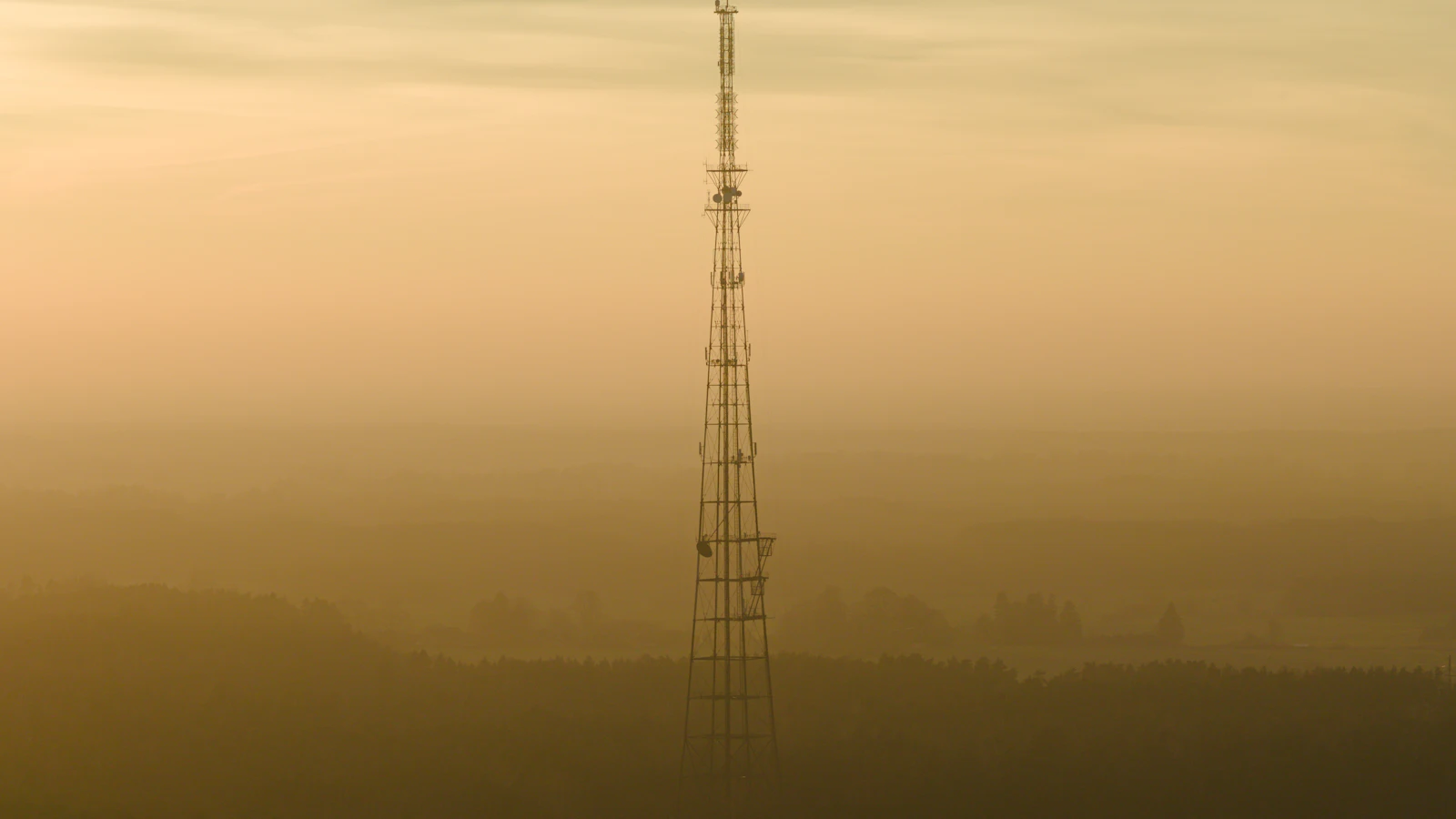
Telecom tower maintenance is the routine work that keeps a mast standing, safe to climb and fit to carry its equipment: structural and corrosion checks, bolt and guy inspections, foundations, antennas and feeders, earthing, aviation obstruction lights, fall protection systems and the site around the tower. A good programme combines scheduled inspections, extra checks after storms and ice, a structural review before any new equipment goes up, and hands-on repairs by trained climbers. Drones now carry much of the survey and inspection work, but they do not tighten bolts, change lamps or replace connectors.
We fly telecom and utility inspections across the Nordics, so we see how inspection data feeds into maintenance planning. This guide is for tower owners, operators and asset managers who want a clear picture of what a cell tower maintenance programme should cover, which standards and rules apply in Europe and Finland, and where drone surveys fit alongside climbing crews.
Table of contents
What telecom tower maintenance covers
A tower is a structure, an electrical installation, an aviation obstacle and a workplace at the same time, and maintenance has to cover all four.
| Area | What is checked | Typical problems |
|---|---|---|
| Structure | Legs, bracing, platforms, plumb and twist of the mast | Bent or missing members, damage from ice fall or impact, deformation after storms |
| Corrosion and coatings | Galvanising, paint, welds, member ends, drainage points | Rust at joints and connections, coating loss, trapped water |
| Bolts and fixings | Bolted joints, flange connections, antenna mounts, cable clamps | Loose, missing or corroded bolts, slipped clamps |
| Foundations and guys | Concrete, anchor bolts, guy anchors, guy tension, terminations | Cracked concrete, soil movement, slack or overtensioned guys, corroded anchors |
| Antennas, feeders and RF equipment | Antenna and dish mounts, radio units, cables, connectors, weatherproofing | Shifted antennas, chafed or unsupported cables, water ingress at connectors |
| Earthing and lightning protection | Air terminals, down conductors, bonding, earth electrodes, surge protection | Broken bonds, corroded joints, damaged surge protection devices |
| Aviation obstruction lights | Lamps, controllers, alarms, day markings | Failed lamps, faulty alarms, faded paint |
| Access and safety systems | Ladders, fall arrest rails or cables, anchor points, rest platforms, signage | Worn or damaged fall arrest systems, missing RF warning signs |
| Site | Fencing, access road, equipment shelters, vegetation, drainage | Trees growing towards guys or cables, blocked access in winter, damaged fences |
Corrosion deserves particular attention because it is slow, cumulative and depends on location. ISO 9223 groups atmospheres into corrosivity categories from C1 (very low) to CX (extreme), and the American Galvanizers Association puts zinc loss at 0.1 to 0.7 µm a year in a C2 rural setting, against 2.1 to 4.2 µm in a C4 setting with higher pollution or a substantial chloride effect. A galvanised mast on the coast or near industry therefore needs closer watching than the same mast inland.
Standards and rules that apply
Structural design: EN 1993-3-1 and TIA-222
In Europe, lattice towers and guyed masts are designed to EN 1993-3-1 (Eurocode 3, Part 3-1: Towers, masts and chimneys), published in 2006, with each country setting its own choices in a national annex. Its second-generation replacement, EN 1993-3:2026, which covers towers, masts and chimneys in one part, was approved in March 2026 and is currently listed alongside the 2006 parts (as of November 2026). The guys themselves fall under EN 1993-1-11. Ice loading is handled in an annex of the standard, with ice classes for glaze and rime set for each location.
The American standard ANSI/TIA-222 is also referred to in the tower industry, particularly by companies with US operations. Its current edition, TIA-222-I, took effect on 1 January 2024. It requires a post-modification inspection whenever a mount is newly installed or structurally modified, requires mount-to-tower interaction analysis, and lists drones as an acceptable method of collecting data.
RF exposure
The main international reference for radio frequency exposure limits is the ICNIRP 2020 guidelines, covering 100 kHz to 300 GHz. For the public, the EU baseline is Council Recommendation 1999/519/EC. For workers, Directive 2013/35/EU requires employers to assess electromagnetic field risks and keep exposure within set limit values. In Finland, public exposure is covered by Ministry of Social Affairs and Health Decree 1045/2018 and worker exposure by Government Decree 388/2016, which is based on the 2013 directive. In practice, work near live antennas needs a site-specific RF assessment and sometimes a shutdown agreed with every operator on the tower.
Working at height
Directive 2009/104/EC sets the EU minimum requirements for temporary work at height, including specific provisions on rope access and positioning techniques. The European Commission's non-binding guide explains how to choose equipment based on a risk assessment, and tower owners usually add their own climbing and rescue requirements.
Aviation obstruction lights in Finland
Traficom's obstacle guidance (page updated July 2026) requires obstruction lights on structures taller than 45 m within the circling approach area of an airport, about a 10 km radius, on structures taller than 70 m elsewhere, and on structures that penetrate or come very close to an aerodrome's obstacle limitation surfaces. The owner is responsible for keeping the lights working, faults and their repair schedule must be reported to Traficom immediately, and lights may not be removed without permission. An obstacle permit itself is needed for structures over 60 m elsewhere, and over 30 m within 45 km of an airport.
Lightning protection
ITU-T Recommendation K.56 (2021) covers lightning protection of radio base stations: it uses the IEC 62305-2 risk method to set a protection level and then deals with bonding, earthing and surge protection devices. Maintenance checks are about keeping that design intact as equipment is added and removed.
How often towers should be inspected
There is no single EU rule that sets a cell tower inspection interval. Owners set their own, usually based on the design standard, the tower type and the environment. TIA-222-H recommends a full inspection every three years for guyed towers and every five years for self-supporting towers and monopoles. Earlier editions also called for inspections after severe wind or ice storms and shorter intervals at coastal and corrosive sites.
| Trigger | What happens |
|---|---|
| Routine site visit | Visual check of the site, lights, fencing, cables and anything visible from the ground |
| Periodic structural inspection | Full condition survey of the structure, fixings, guys, foundations and safety systems (every 3 to 5 years under TIA guidance) |
| Severe weather | Check for damage, displaced antennas and guy problems after storms, heavy icing or lightning |
| Before modification | As-built audit and structural analysis before new equipment or a new tenant |
| After modification | Post-modification inspection to confirm the work matches the design |
What shortens the interval: guyed rather than self-supporting design, a corrosive environment, age, frequent icing, heavy equipment loading, a history of defects, or a structure that critical services depend on.
Ice, snow and the Nordic winter
Ice is what most separates Nordic towers from those further south. EN 1993-3-1 distinguishes glaze ice from rime ice, and national annexes set ice classes for each site, with ISO 12494 as a recognised basis for modelling them. Ice adds weight and also increases the area exposed to wind on members, antennas and guys.
A study of ice-related tower failures by the US Army Cold Regions Research and Engineering Laboratory listed 140 collapses of towers from 40 to 2,000 feet tall, and noted that icing also causes guy wire stretch, fatigue from dynamic loading and damage from falling ice. The best known European case is Emley Moor in England, where a tall guyed television mast collapsed on 19 March 1969 with ice on the mast and its cables; the inquiry attributed the collapse to oscillation in steady winds.
For maintenance planning this means:
Inspect before winter. Autumn is the time to find loose fixings, slack guys and damaged cable supports, before they are loaded with rime.
Check after icing events. Heavy rime, freezing rain or a winter storm should trigger a damage check, especially of guys, antenna mounts and anything below the ice fall zone.
Plan around daylight and access. Short days, snowbound access roads and cold all limit what climbing crews and drone teams can do. Our guide to winter drone operations in the Nordics covers the flying side.
Audits before 5G upgrades and tower sharing
Every new antenna, radio unit or tenant changes the load on a tower. Before an upgrade, the owner needs to know exactly what is already installed and whether the structure and mounts can take more. A pre-upgrade audit usually covers:
As-built record. Every antenna, dish, radio unit and cable run, with heights, orientations and mounts. Drawings are often out of date.
Condition. Corrosion, damage and loose fixings that must be fixed before new loads are added.
Structural analysis. A check of the tower and mounts against the design standard with the proposed equipment, including ice and wind.
RF compliance. Updated exclusion zones once new transmitters are added, for the public and for anyone who will climb.
Post-installation check. Confirmation that what was installed matches the design.
Tower sharing makes good records more important. Under the EU Gigabit Infrastructure Act, Regulation (EU) 2024/1309, which applies from 12 November 2025, network operators must meet reasonable requests for access to their physical infrastructure on fair and reasonable terms, share minimum information through single information points and allow on-site surveys. Access can be refused for reasons such as safety or lack of space, so an owner who knows what is on each tower and how much capacity is left can answer requests far more easily.
Climbers or drones: who does what
Climbing remains hazardous work. Looking at 1992 to 1997, NIOSH estimated fatal injury rates for US tower workers at 49 to 468 per 100,000, against about 5 per 100,000 for all US industry, with falls as the main cause. Taking survey work off the tower reduces time at height, but anything that needs hands on the structure still needs a climber.
| Task | Drone survey | Climber |
|---|---|---|
| Visual condition survey of structure and coatings | Yes | Yes |
| Antenna as-built audit and measurements | Yes, from a 3D model | Yes, by hand |
| Storm and ice damage check | Yes, quickly and without climbing a damaged structure | After the structure is confirmed safe |
| Vegetation and site overview | Yes | Not needed |
| Bolt torque checks and tightening | No | Yes |
| Guy tension measurement and adjustment | Can spot visible slack | Yes |
| Replacing lamps, connectors, cables and antennas | No | Yes |
| Earthing continuity tests | Can spot visible damage | Yes |
| Fall arrest system inspection | Visual only | Yes, hands-on |
A practical approach is to use drone surveys to find and record problems, then send climbers with the right parts for known tasks. Our guide to telecom tower inspections with drones explains how a drone survey is flown and what it delivers.
Choosing a tower maintenance or inspection provider
Whether you are hiring cell tower inspection companies, a climbing contractor or both, ask:
Competence. Are climbers trained and certified for work at height and rescue? For drone work, is the operator registered, and does it hold the authorisations the sites need?
Standards. Which design standard and national annex will findings be assessed against, and who signs off structural conclusions?
RF safety. How does the provider handle RF assessments and coordinate shutdowns with every operator on a shared tower?
Deliverables. Will you get photos, a 3D model, an as-built list and a prioritised defect list in a format that fits your asset system?
Repeatability. Can the next inspection be compared with this one, so corrosion and defects can be tracked over time?
Data handling. Who owns the data, where is it stored and who can see it?
Cell tower inspection cost depends mainly on tower height and type, the number of sites, travel and access, the analysis required, and whether RF shutdowns or climbing are needed. Prices per site on a defined scope make quotes comparable.
Frequently asked questions
What does cell tower maintenance include?
It covers the structure, corrosion protection, bolts and fixings, foundations and guys, antennas and feeders, earthing and lightning protection, aviation obstruction lights, climbing and fall arrest systems, and the site around the tower. It combines periodic inspections with repairs and checks after severe weather.
How often should a cell tower be inspected?
There is no EU-wide interval. TIA-222-H recommends a full inspection every three years for guyed towers and every five years for self-supporting towers and monopoles, with extra checks after storms, heavy icing or modifications. Corrosive sites and older structures justify shorter intervals.
Can a drone inspect a cell tower instead of a climber?
A drone can carry out the visual survey, as-built audit and damage checks without anyone climbing. Hands-on work such as torque checks, guy tensioning and replacing parts still needs a climber.
Who is responsible for aviation obstruction lights on a mast in Finland?
The owner of the obstacle. According to Traficom, faulty lights and the repair schedule must be reported to Traficom immediately, and lights may not be removed without permission.
What standards apply to telecom towers in Europe?
Design follows EN 1993-3-1 for towers and masts, with national annexes, and some tower companies also refer to TIA-222. RF exposure follows the ICNIRP guidelines and EU rules, and work at height follows Directive 2009/104/EC.
Planning tower inspections?
Drone surveys give you a measurable record of each tower before maintenance, upgrades or sharing requests. See our Tower Assessment 3D (TA-3D) service or contact us to discuss your sites.
Sources
European Commission JRC: Eurocode 3, Design of steel structures
Danish Standards: National annex to EN 1993-3-1 (Greenland, 2025), ice classes
MarketScale: 4 keys to a quality tower inspection (TIA-222-H intervals)
American Galvanizers Association: HDG corrosion rates for ISO categories C1 to CX
EUR-Lex: Directive 2013/35/EU on electromagnetic fields at work
Finlex: Decree 1045/2018 on limiting public exposure to non-ionising radiation
Finlex: Government Decree 388/2016 on protecting workers from electromagnetic fields
Lexaris: Directive 2009/104/EC (contents, Annex II on work at height)
ITU-T: Recommendation K.56 (2021), protection of radio base stations against lightning
CRREL (Mulherin, IWAIS 1996): Atmospheric icing and tower collapse in the United States
Pocklington Post: The day the Emley Moor TV mast came crashing down
NIOSH: Preventing injuries and deaths of workers who construct and maintain telecommunication towers


