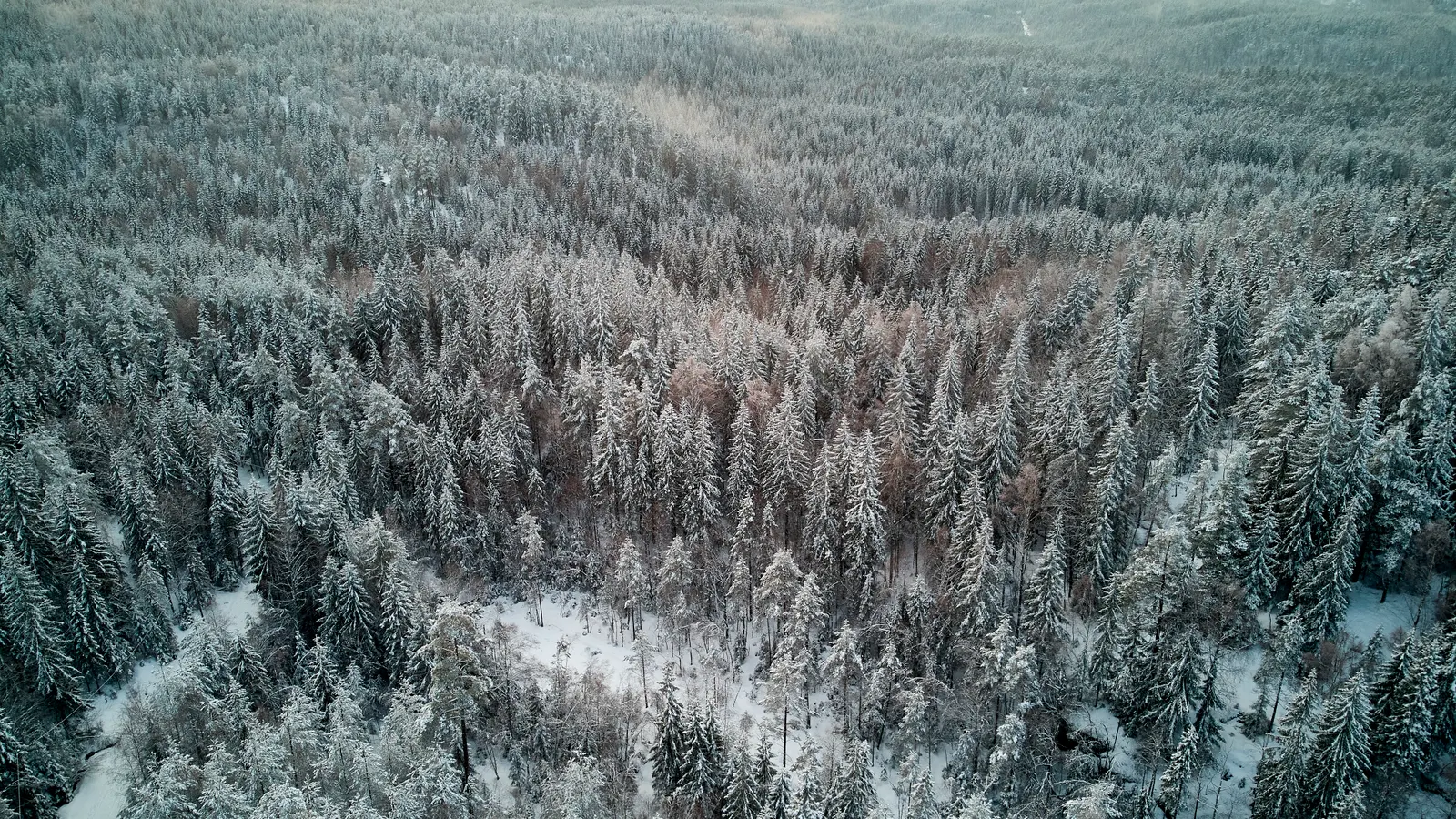
Drone inspections and surveys carry on through a Nordic winter, but the season changes what is possible and when. Short days cut the flying window to a few hours, cold reduces battery endurance, freezing fog can ice up a drone, and snow hides the ground that mapping and inspection rely on. Some work suits winter well, such as construction progress mapping or thermal surveys of building heat loss. Some is better left for spring, such as thermal inspections of solar farms. Planning around these factors is what keeps a winter project on schedule.
This guide is for clients planning drone work in Finland, Sweden, Norway and Denmark between November and March: what winter changes, which services it affects most, and how to plan for it.
Table of contents
What winter changes
| Factor | Effect on drone work | What to plan for |
|---|---|---|
| Short days | Only a few hours of good light, less in the north | Fewer sites per day, flexible scheduling |
| Cold | Batteries deliver less energy, equipment needs warming | Shorter flights and more of them |
| Freezing fog and drizzle | Ice can build up on propellers | Weather days and a fallback date |
| Snow cover | Hides ground features and changes surfaces | Choose deliverables that still make sense under snow |
| Wind and storms | Winter storms ground flights for days at a time | A wider weather window |
Our guide to drone weather limits covers wind, rain and temperature in more detail. This guide focuses on what winter means for planning a project.
Short days
Daylight is the tightest limit. On the winter solstice, Helsinki gets about 5 hours 49 minutes of daylight, and Oulu about 3 hours 34 minutes. In the far north, above the Arctic Circle in Lapland and northern Norway and Sweden, the sun does not rise at all for days or weeks around midwinter, and for almost two months at Finland's northern tip.
Flying after dark is allowed in many cases. In the EU open category, a drone flown at night must have a green flashing light switched on. Specific category operations need one too, plus whatever the operator's authorisation requires. But darkness still matters for the job itself. Visual inspections and mapping need good light to produce sharp, evenly lit images, so most winter projects are planned around the middle of the day. In practice, that means fewer sites per day than in summer, so a campaign takes longer.
Cold and battery endurance
Lithium batteries deliver less energy in the cold. In its winter safety guidance, the UK Civil Aviation Authority explains that cold slows the chemistry inside lithium cells, so a battery runs for less time and may give less power. It also warns that a phone or tablet used to control the drone can drain fast or switch off without warning in the cold. Larger enterprise drones, such as the DJI Matrice 350 RTK, are rated down to -20°C and have self-heating batteries, while compact enterprise models are often rated only to -10°C. Either way, endurance drops as the temperature falls.
For a client, the practical effect is that each flight covers less ground. A turbine, roof or site that takes one battery in summer may take two in January. Allow for more flights, more battery changes and a little more time on site.
Icing and freezing fog
Icing is one of the most serious weather risks for drones in a Nordic winter. It happens when a drone flies through supercooled water, droplets in fog, low cloud or drizzle that stay liquid below 0°C and freeze on contact. Propellers are especially exposed. In one Iowa State University flight test, a small fixed-wing drone that picked up ice on its propeller and airframe used over 80% more power to fly the same mission.
Small drones generally have no ice protection, so the safe answer is not to fly in icing conditions at all. Freezing fog and low cloud are frequent in Nordic winters and can linger for much of the day. A winter project needs weather days built into the plan, so that a foggy morning becomes a delay rather than a risk.
Snow on the ground
Snow changes what a drone can usefully capture.
Mapping. Fresh, even snow has very little texture, which makes it harder for photogrammetry software to match images, and it hides ground features, markings and edges. Snow-covered stockpiles also measure higher than the material underneath, so volume calculations taken under snow need care.
Inspections. Snow and ice on roofs, ledges and equipment can hide defects. A roof survey under 20 cm of snow tells you about the snow, not the roof.
Progress records. For construction progress, snow matters less. Structures, cranes, cladding and site logistics are still clearly visible, and a regular record through the winter keeps the timeline complete.
Which services work in winter
Wind turbine inspections
Ice on turbine blades brings its own hazard. Pieces of ice can fall from a stationary turbine or be thrown from a turning one, and a 2015 Uppsala University thesis modelled throw distances of about 240 m downwind of a 3.3 MW turbine in strong wind, and further still when the ice fragments generate lift. Ice also hides the blade surface that an inspection needs to see. For these reasons, planned blade inspections are usually scheduled for the ice-free months. In winter, drones are more useful for targeted checks, such as after a storm or a lightning strike, when the blades are free of ice. See our wind turbine inspection service.
Construction sites and mapping
Construction carries on through the winter, and so does the need for progress records. Regular flights give project teams a consistent view of the site through the months when walking it is slowest. Detailed terrain surveys and volume calculations are best timed for snow-free periods, or planned with the snow in mind. See our drone mapping and survey service and construction site inspections.
Thermal inspections
Winter is a good season for one kind of thermal survey and a poor one for another.
Buildings and heat loss: good in winter. Thermal imaging of buildings works best with a large difference between inside and outside temperatures, at least 5°C and ideally 10°C or more, and with no sun on the surfaces beforehand. Cold, overcast days and the early dark make winter a natural season for heat loss surveys of roofs and facades.
Solar farms: wait for spring. Thermal inspection of solar panels needs strong sunlight on the panels. The IEC TS 62446-3 standard calls for at least 600 W/m² of irradiance, a level the midwinter sun does not reach. By March, clear days can bring enough sun, but snow often still covers the panels. Plan solar thermal inspections for spring and summer. See our thermal inspection service.
Telecom towers
Tower inspections and 3D models can be flown in winter on clear, calm days, but ice on antennas and structures can hide the details an inspection is looking for. Equipment audits and planning models work well in winter; detailed condition inspections are better in milder months. See our telecom tower inspections.
Planning a winter project
Say what the data is for. A progress record, a heat loss survey and a volume calculation have very different winter requirements.
Allow a wider window. A job that takes one day in June may need a window of a week or two in January to find suitable weather.
Agree how weather days are handled. Decide upfront who makes the call and how rescheduling works, so a foggy morning doesn't turn into a dispute.
Keep the site accessible. Cleared access roads and a safe take-off area save time, especially at wind farms and remote sites.
Plan the permits as usual. Airspace approvals and authorisations take as long in winter as in summer. See our guides to commercial drone rules in Finland and Sweden.
Book seasonal work early. If your project needs snow-free ground or summer sun, book it before spring, when demand peaks.
Frequently asked questions
Can drones fly in winter?
Yes. Professional drones fly through the Nordic winter, but short days, cold, icing and snow reduce how much can be done each day and rule out some jobs until spring.
How cold is too cold for a drone?
It depends on the aircraft. Larger enterprise drones are often rated down to -20°C, compact enterprise models to around -10°C, and smaller consumer drones to around -10°C or 0°C. Below the rated limit, a drone should not fly, and battery endurance falls well before that point.
Can drones fly in snow or fog?
Falling snow, freezing fog and drizzle are usually reasons not to fly, because moisture can freeze on the propellers and reduce lift. Clear, cold, calm days are often good flying weather.
When is the best time for solar panel thermal inspections in the Nordics?
Spring and summer. Thermal inspections of solar panels need strong sunlight, at least 600 W/m² under IEC TS 62446-3, which the midwinter sun does not provide.
Can wind turbines be inspected in winter?
Sometimes, on clear days with no ice on the blades. Ice throw and ice-covered blades make winter a poor season for planned campaigns, which are usually scheduled for the ice-free months.
Planning drone work this winter?
We fly across the Nordics all year and plan every project around the season. Contact us to talk about what is possible this winter, or what to book for the spring.
Sources
EUR-Lex: Implementing Regulation (EU) 2020/639 (green flashing light at night)
thisisFINLAND: When the sun doesn't rise in northern Finland
Girod and Filhol (University of Oslo), ISPRS 2020: Drone photogrammetry over snow
Uppsala University: Modelling of ice throws from wind turbines
Teledyne FLIR: Thermal inspection of solar panels (IEC TS 62446-3)


