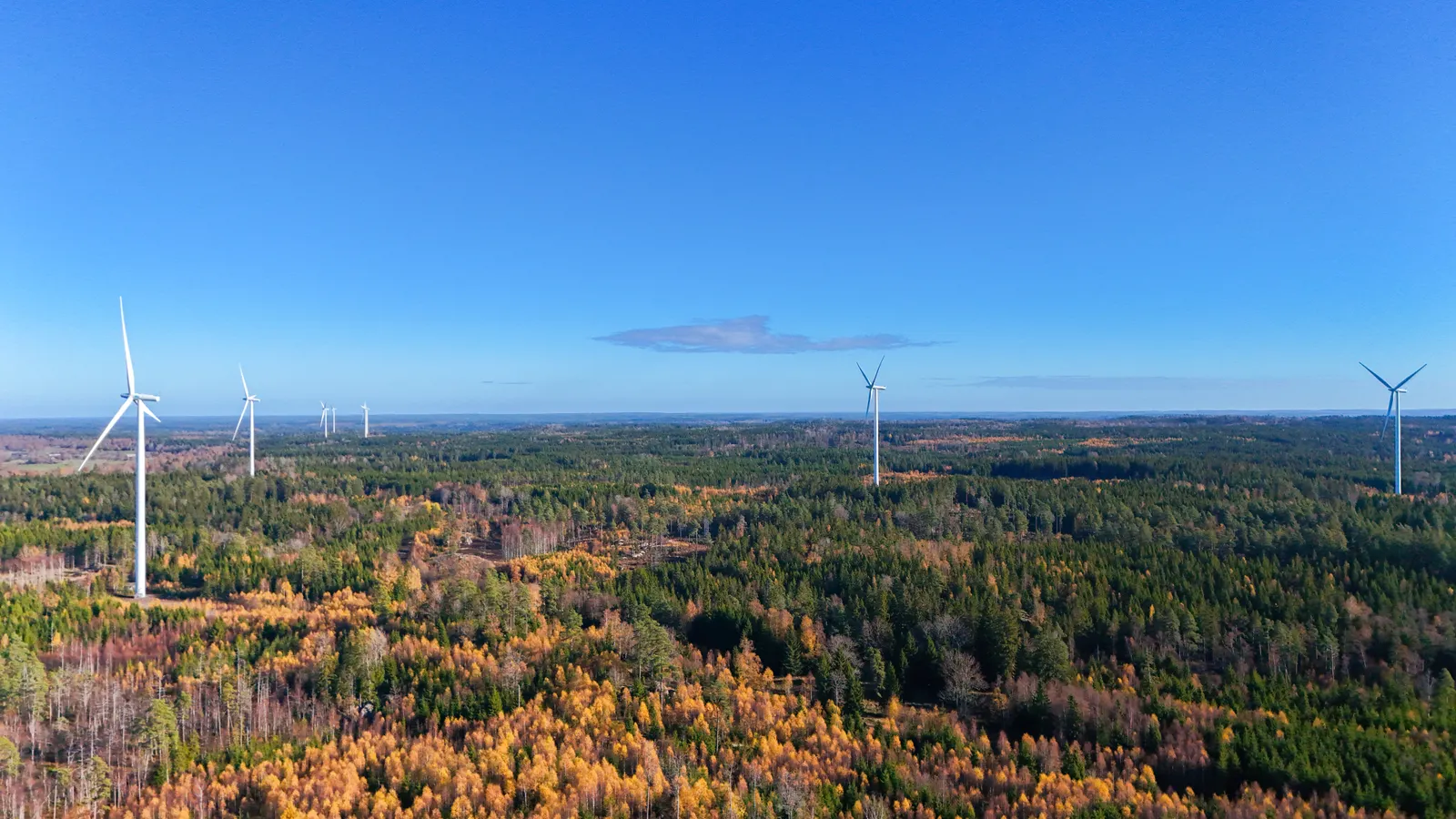
In 2026, Flyby Guys has inspected 1,047 wind turbines by drone, for several clients, across Finland, Sweden, Norway, Denmark and the Faroe Islands. The turbines range from older, smaller machines to modern turbines with blade tips more than 200 m above the ground. This post covers what that volume of wind turbine drone inspection has taught us, using one autumn campaign as a worked example, and what wind farm owners can take from it when planning their own inspections.
Our clients' work is confidential, so we don't name them, their turbines or their sites.
2026 in numbers
1,047 turbines inspected by drone so far this year.
Five countries: Finland, Sweden, Norway, Denmark and the Faroe Islands.
Several clients, each with its own fleet, schedule and reporting needs.
One campaign in detail
One campaign shows what this work looks like up close. Between mid-September and late October, for a single client, our pilots inspected more than 100 turbines spread across all five countries, from forest sites inland to exposed coastal and island locations, in about six weeks.
That meant moving teams and equipment between countries every few days, adapting to a different mix of turbines at almost every site, and keeping to a schedule the client could rely on.
"I want to thank our customers for the trust they put in us this year. But the biggest thanks goes to our pilots, who travelled across five different countries in such a short timeframe and still delivered on time."
Stephen Sutton, CEO, Flyby Guys
Why Nordic wind farms need inspection at scale
Nordic wind power is mostly onshore and spread over a lot of ground. Finland had 2,002 wind turbines and 9,433 MW of capacity at the end of 2025, and wind produced 28% of the country's electricity that year, according to Renewables Finland. Around three quarters of that capacity is in the Ostrobothnia regions on the west coast. Sweden has more than 18 GW of installed wind power.
For an owner or service provider, that means fleets of turbines scattered across forests, farmland and coastlines, often hundreds of kilometres apart. Inspecting them one call-out at a time is slow and expensive. Grouping them into a single campaign, with one team, one method and one dataset, is far more efficient.
What a drone wind turbine inspection involves
A drone blade inspection follows the same basic steps on every turbine:
Stop the rotor. The turbine is stopped and the blades set in a fixed position, agreed with the turbine operator before the flight.
Fly each blade. The drone flies a planned path along every blade, photographing each side at close range.
Cover the tower and nacelle. The same flight usually covers the tower surface and the outside of the nacelle and hub.
Review the images. The images are checked for damage and each finding is tied to the turbine and the position on the blade.
The main things a blade inspection looks for are leading-edge erosion, cracks, lightning damage and trailing-edge splits. Speed is the big advantage over rope access. At the BARD Offshore 1 wind farm, drone inspection took about 25 minutes per turbine, against half a day to a full day by rope. Our guide to wind turbine inspection with drones explains the methods in more detail.
Keeping track of hundreds of inspections
At more than 1,000 turbines a year, the flying is the easy part. The hard part is keeping track: which turbines are done, which are waiting for review and which still need a visit. The autumn campaign above was run entirely in FlybyOps, our own drone operations platform.
One project per country, one job per turbine. Each job held the turbine's serial number, the client's order number, the turbine type, the site, the tower height and a mapped flight area.
The right details before arrival. Pilots knew the turbine type and tower height before they reached the site, so the flight could be planned for that machine.
A review step for every turbine. Each inspection was submitted and then approved before the turbine counted as done, which gives the client a clear record of what was inspected and when.
That structure matters more as the numbers grow. On a ten-turbine job a spreadsheet works. At more than 100 turbines in five countries, you need to see at a glance which are done, which are waiting for review and which still need a visit. Our guide to drone operations management platforms covers this in more depth.
From small towers to 200 m blade tips
No two fleets are the same. Across the year we have inspected everything from older turbines on towers under 50 m to modern machines whose blade tips reach more than 200 m above the ground at the top of their sweep.
That range changes the flying:
Longer blades mean longer flights. A modern blade can be more than three times the length of an older one, so each inspection takes more images, more time and more battery.
Wind is stronger at height. Wind speed usually increases with height, so a calm morning at the base of a 130 m tower can still be too windy at the hub.
The flight plan follows the machine. Blade length, hub height and tower shape all feed into the flight path, which is why knowing the turbine type in advance saves time on site.
Working with the Nordic seasons
Inspecting more than 1,000 turbines in a year means working with the seasons. Autumn is a good window, but a short one. The days shorten quickly, the wind picks up, and exposed coastal and island sites can lose whole days to weather. A campaign has to keep moving between sites and countries so that a bad day in one place doesn't stall the whole schedule. Our guide to drone weather limits covers how wind, rain and cold affect flying.
Planning a wind turbine inspection campaign
If you own or maintain turbines in several places, these are the things that make a campaign run well:
Share the turbine data up front. A list with each turbine's ID, type, coordinates and tower height lets the operator plan every flight before travelling.
Book the season early. Late summer and autumn fill up quickly, and the weather window closes as winter arrives.
Keep the method the same every year. Consistent images from the same angles make it much easier to see whether damage is growing.
Agree how findings are graded. Blade damage is usually sorted into severity categories that set how quickly it needs repair. One 2024 study in Applied Energy, for example, lists erosion down to the laminate as a repair within six months, and erosion into the first laminate layer as a repair within three months.
Early detection pays. A 2024 study in Wind Energy Science modelled annual energy losses of up to 2.9% per turbine from leading-edge erosion, which adds up quickly across a fleet.
Frequently asked questions
How long does a drone wind turbine inspection take?
Usually under an hour per turbine on site. At BARD Offshore 1, a drone inspection of the blades and tower took about 25 minutes per turbine. Travel between sites often takes longer than the flying.
Who inspects wind turbines by drone in the Nordics?
Specialist drone operators, working for wind farm owners, operators and service companies. Flyby Guys is based in Helsinki and has inspected 1,047 turbines in Finland, Sweden, Norway, Denmark and the Faroe Islands in 2026.
Does the turbine have to stop for a drone inspection?
Yes. The rotor is stopped and the blades are locked in position so the drone can fly along each one safely.
How often should wind turbine blades be inspected?
It depends on the site and the turbine's history. Inspection providers report intervals from every couple of months to once a year. Tall turbines and those near the sea are more prone to erosion, and blades with known damage are usually checked more often.
Can one operator inspect turbines in several countries?
Yes. Each country has its own aviation authority and local rules, so the operator needs the right permissions in each one, but a single team and method can cover the whole fleet. Our guide to commercial drone rules in Finland shows what that involves in one country.
Planning turbine inspections in the Nordics?
We have inspected 1,047 wind turbines across the Nordics this year, from single sites to multi-country campaigns. See our wind turbine inspection service, or contact us to plan your next inspection round.
Sources
Renewables Finland: More than 1,000 MW of new wind power built in Finland in 2025
Renewables Finland: Finland now has over 10 GW of wind and solar power
oEnergetice: Wind power development in Sweden (Green Power Sweden data)
ESVAGT: Safe, fast and efficient inspection with drones (BARD Offshore 1)
Visbech et al. (2024), Wind Energy Science: Aerodynamic effects of leading-edge erosion
Lopez et al. (2024), Applied Energy: Reliability-based leading edge erosion maintenance strategy


