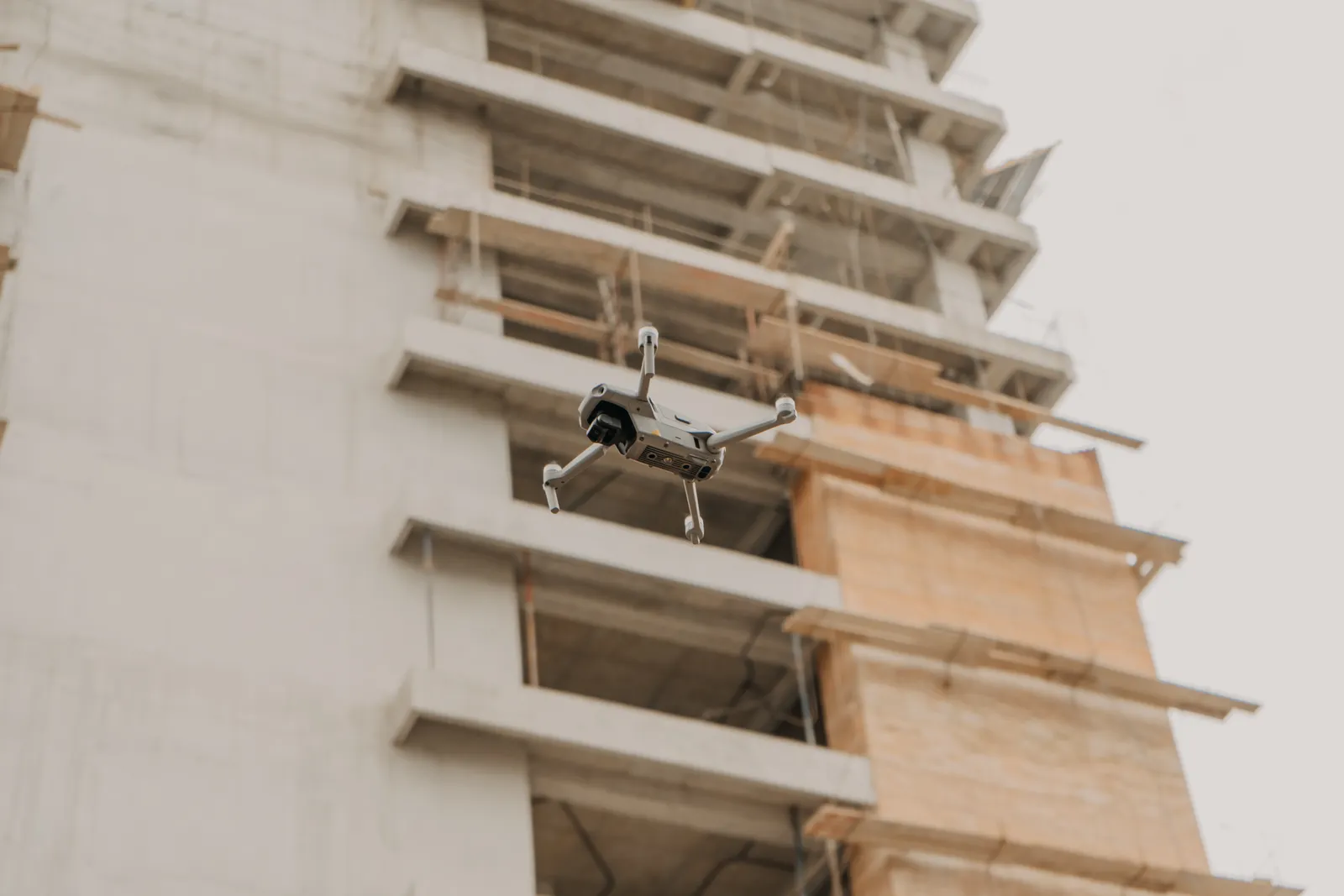
Choosing a drone inspection contractor comes down to five things: the right authorisations for your work in every country involved, adequate insurance, safe and secure handling of your data, proven experience at the scale you need, and deliverables your engineers can actually use. Price matters, but a contractor who cannot get permission to fly your site, or whose images your team cannot use, can cost more in the end. The questions below are the ones we would ask if we were on the buying side.
This guide is written for procurement teams, asset managers and project managers at construction, energy and telecom companies who are hiring a drone service provider, whether for a single site or a campaign across several countries.
Table of contents
1. Authorisations and approvals
Drone operators in the EU must register with the aviation authority of the country where they are based if they fly drones of 250 g or more or with a camera, which covers virtually all inspection work. Much professional inspection work also falls into the specific category, which needs an operational authorisation. Flights close to people, in built-up areas, around critical infrastructure or beyond visual line of sight usually need one.
Ask: What category will our work be flown in, and do you hold an authorisation that covers it? Can we see it?
Check: that the authorisation covers the type of operation, the drones and the area you need, and that it is current. Some authorities publish lists of registered operators, and Norway's aviation authority advises clients to check what an operator's authorisation covers before hiring; in Norway you can also request a copy of an operator's authorisation through einnsyn.no. A new authorisation can take many months: Traficom in Finland quotes about 12 months, and Sweden's Transportstyrelsen has a queue of six to seven months before a caseworker is even assigned. A contractor who still needs to apply is unlikely to fly your project this season.
2. Cross-border work
If your assets are spread across several countries, the contractor needs to be cleared to fly in each one. For work that needs a specific category authorisation, an operator authorised in one country must apply to the authority of each other country it will fly in, and can start once that authority confirms the local safety measures. Every country also has its own local rules on top.
Ask: Have you flown in these countries before? Which approvals do you already hold, and how long will the rest take?
Watch for: national extras that are easy to miss. Sweden requires a permit from Lantmäteriet before most aerial images can be shared. Norway has no-sensor zones, listed by its National Security Authority, where photographing, filming or using other sensors from the air is banned, and requires liability insurance of at least 750,000 SDR for almost all drones. Our guides to commercial drone rules in Finland, Sweden and Norway cover the details.
3. Insurance
EU rules make insurance mandatory only for drones of 20 kg or more, but most EASA countries also require third-party liability cover for lighter drones, and some set their own minimum. Norway, for example, requires at least 750,000 SDR for aircraft under 500 kg. Finland does not require it below 20 kg, though Traficom recommends it. Either way, a professional contractor should carry it.
Ask: for a certificate of insurance that names the countries and the type of work, and states the liability limit. If your contract needs it, ask whether your company can be named on the policy.
Our guide to drone insurance for business explains what to look for.
4. Pilots and safety management
The authorisation belongs to the company, but the pilots fly your site. Remote pilots need the qualifications required for the category and the operation.
Ask:
Are your pilots employees or freelancers, and how are they trained for this type of work?
Do you have an operations manual, a safety management process and an emergency response plan?
How do you report and learn from incidents?
Do your pilots hold the site safety training our sites require?
A contractor with a mature safety culture will answer these readily and in writing.
5. Data handling and security
Drone inspections produce detailed images of your assets, and sometimes of people. For critical infrastructure, energy and telecom sites, that data is sensitive.
Ask:
Where is our data stored and processed, and who can access it?
Which software and cloud platforms do you use, and where are their servers?
How long do you keep our data, and how is it deleted?
How do you meet the GDPR when people appear in the images?
Can you sign our confidentiality and data processing agreements?
Security of the drones themselves is getting more attention too. A study for the European Commission has proposed a European Trusted Drone Label, initially voluntary, covering areas such as secure firmware and data protection. Final recommendations are due in January 2027. It is not available yet, but it may start to appear in public tenders. We covered it in our EU Drone Summit 2026 recap.
6. Deliverables
The flight is only half the job. What matters to your team is what arrives afterwards.
Ask:
Can we see a sample deliverable from similar work?
How are images organised, for example by turbine, blade, tower section or grid area?
Which formats do you deliver, and do they work with our GIS, CAD, BIM or asset management systems?
For mapping, what accuracy will you achieve and how will it be checked?
How quickly will we receive the data after each flight?
Be clear about who interprets the results. Some contractors deliver images; others also grade the findings. If your engineers or a specialist will do the assessment, agree the format with them before the work starts.
7. Experience at scale
Inspecting one site and running a campaign across dozens of sites and several countries are different jobs. At scale, the hard part is not the flying but keeping track: which assets are done, which are waiting for review and which still need a visit.
Ask: What is the largest comparable project you have delivered? How do you track progress across sites, and how will we see it? Can we speak to a reference client?
For context, in 2026 our pilots inspected 1,047 wind turbines across five countries, and our case studies cover projects such as weekly mapping of a 48 MW data centre build.
8. Planning, permits and weather
Drone work depends on airspace permissions and weather, so a clear plan for both avoids disputes later.
Ask:
Who applies for airspace permissions and local approvals, and how long do they take?
What are your weather limits, and how are weather days handled in the schedule and the price?
What do you need from us, such as site access, inductions, turbine stops or asset lists?
Seasons matter in the Nordics. Some work, such as thermal inspections of solar farms, needs summer sun, while short winter days slow most campaigns. See our guide to drone weather limits.
Checklist for your tender
| Request | Why it matters |
|---|---|
| Operator registration and operational authorisation(s) | Proves they can legally fly your work |
| Approvals or plan for each country involved | Avoids months of delay on cross-border projects |
| Certificate of insurance | Confirms cover, limits and countries |
| Operations manual and safety process summary | Shows a mature safety culture |
| Data handling description and signed DPA | Protects sensitive asset data |
| Sample deliverable | Shows what your engineers will receive |
| Reference projects and a contact | Proves experience at your scale |
| Weather and rescheduling terms | Prevents disputes over delays |
Frequently asked questions
What should I look for in a drone inspection company?
The right authorisations for your work in every country involved, adequate insurance, trained pilots and a safety process, secure data handling, usable deliverables and proven experience at your scale.
How do I check a drone operator is authorised?
Ask for their operator registration number and operational authorisation, and check that the authorisation covers your type of operation, drones and area. Some national aviation authorities publish lists of registered operators.
Can one drone contractor work in several European countries?
Yes. For specific category work, an operator authorised in one EU or EASA country applies to each other country's authority to fly there under its existing authorisation, and must follow local rules everywhere it flies.
Should I own drones or hire a contractor?
Owning drones makes sense for frequent, simple flights near your own staff. For specialised inspections, large campaigns or work across several countries, a contractor with the authorisations, pilots and experience in place is often faster to deploy.
Planning a tender for drone services?
We are happy to answer these questions for your project. See our services for wind turbine inspections, drone mapping and surveys and construction sites, or contact us.


