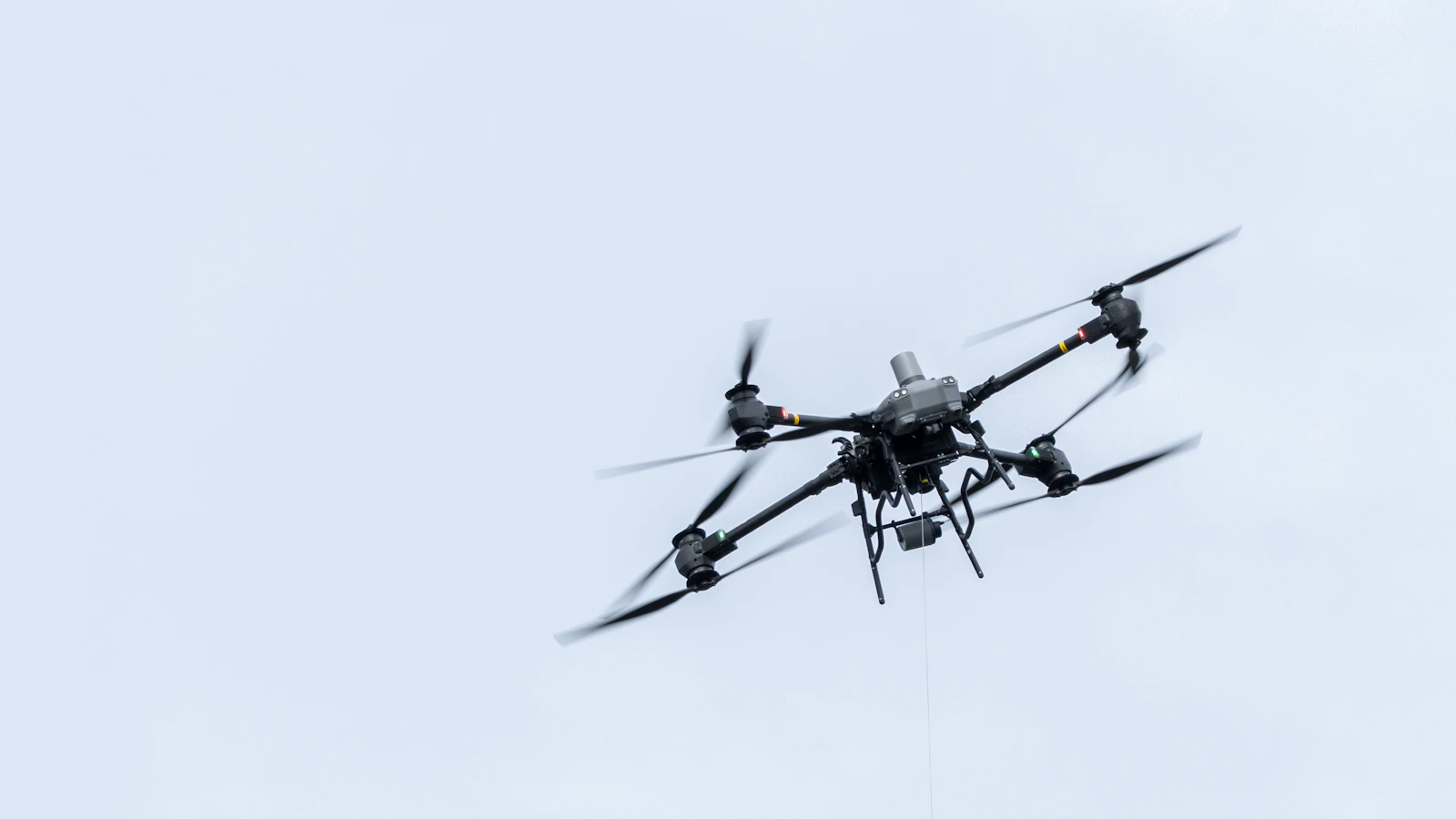
About 2.5 million drone operators were registered across the EASA countries in late 2025, according to EASA's drone operations dashboard, with Germany (around 825,000), Poland (436,521), Italy (185,180) and France (182,626) holding the largest registers. These figures count operators, meaning the person or organisation responsible for a drone, not individual drones or remote pilots. In the Nordics, the same dashboard lists 52,516 operators in Sweden, 34,429 in Norway, 23,071 in Finland and 21,918 in Denmark. Outside EASA, the UK Civil Aviation Authority had 321,347 active operator registrations on 31 March 2026.
We fly commercially across the Nordics and Europe, and every job we do starts with an operator registration in our home country. This page brings together the latest figures each authority publishes, as of November 2026, with the date and source for each number, and explains why the registers are hard to compare.
Table of contents
What registration counts and who must register
Under the EU drone rules, it is the operator who registers, not each drone. Operators register in the country where they live or, for organisations, where they have their principal place of business. Transportstyrelsen puts it plainly: an operator cannot be registered in more than one EU member state at a time, and an operator ID issued in one member state is valid in all of them.
In the open category, you need to register if you fly a drone of 250 g or more, or any drone with a camera or other sensor that can capture personal data. Toys and very light drones without a camera are exempt. In the specific category, operators register whatever the drone weighs. Our guide to EU drone regulations covers the categories in more detail.
Pilot competency is a separate record. A remote pilot proves competency by passing a theory exam (for example the online A1/A3 test), and those certificates are counted separately from operator registrations. One operator can have many pilots and many drones. The UK uses different names for the same idea: an Operator ID for whoever is responsible for the drone and a Flyer ID for the person flying it. Our article on Flyer ID vs Operator ID explains the UK system.
Registered drone operators by country
The table shows the most recent figure we could verify for each country. Where the national authority publishes its own total, we use that. Where it does not, we use EASA's drone operations dashboard, which collects figures from national authorities. The dashboard rows carry a late 2025 reference date. Figures marked as press reports come from news coverage rather than the authority itself.
| Country | Authority | Operators registered | Date | Notes |
|---|---|---|---|---|
| Finland | Traficom | 23,071 | Late 2025 (EASA dashboard) | Traficom said in May 2024 that Finland had over 17,800 registered operators and over 27,000 remote pilots. |
| Sweden | Transportstyrelsen | 52,516 | Late 2025 (EASA dashboard) | No regularly published national total found. An industry survey in 2026 was sent to 3,834 organisations in the operator register, up from 3,560 in 2025. |
| Norway | Luftfartstilsynet | 34,429 | Late 2025 (EASA dashboard) | Luftfartstilsynet's 2025 annual report lists 119 drone operators under its supervision and 6 LUC holders. |
| Denmark | Trafikstyrelsen | 21,918 | Late 2025 (EASA dashboard) | No national total found. |
| Estonia | Transpordiamet | 4,816 | Late 2025 (EASA dashboard) | ERR reported in April 2026 that more than 8,000 drone pilots were registered with Transpordiamet (press report, pilots rather than operators). |
| Latvia | Civil Aviation Agency | 11,242 | End of 2025 | Up from 7,846 at the end of 2024. More than 20,000 remote pilots. The EASA dashboard shows 6,445. |
| Germany | Luftfahrt-Bundesamt (LBA) | About 825,000 | Late 2025 (EASA dashboard) | A rounded figure. We found no recent LBA release. In 2021 the LBA reported 257,192 operators as of 30 April 2021 (as reported by Alpinflieger). |
| France | DGAC | 148,874 | DSAC activity report 2024 | The EASA dashboard shows 182,626. France also counted 387,260 registered drones on 31 December 2024. |
| Netherlands | ILT / RDW | 119,884 | Late 2025 (EASA dashboard) | RDW handles operator registration. No national total found. |
| Spain | AESA | 150,332 | End of 2025 | 30,620 new operators in 2025. 142,809 A1/A3 training certificates issued in 2025. Matches the EASA dashboard. |
| Italy | ENAC (d-flight) | Over 185,000 | 2025 (reported February 2026) | From the Politecnico di Milano drone observatory, as reported by MeteoWeb. Over 148,000 drones registered on d-flight. EASA dashboard: 185,180. |
| Ireland | IAA | Over 9,200 | December 2025 | Counted since 2021. Over 24,000 pilots trained. EASA dashboard: 9,388. |
| EASA total | EASA | 2,508,465 | Late 2025 (EASA dashboard) | EASA said in May 2025 that Europe had more than two million registered operators. |
| United Kingdom (not EASA) | CAA | 321,347 | 31 March 2026 | Active Operator Registrations: 10,685 organisations and 310,662 individuals. 603,015 active Flyer IDs. |
The dashboard is an interactive map, so the dashboard figures here are taken from two published copies of it: Dronedesk's country table and a Swedish industry report published on sUAS News, which quotes an extract dated 12 August 2026. Both give the same figures for the countries they cover, and Dronedesk's country figures add up to the stated EASA total.
The full EASA list
For completeness, here is every country on EASA's dashboard, largest first. All figures carry the same late 2025 reference date. Liechtenstein shows no figure.
| Country | Registered operators |
|---|---|
| Germany | 825,000 |
| Poland | 436,521 |
| Italy | 185,180 |
| France | 182,626 |
| Spain | 150,332 |
| Switzerland | 124,052 |
| Netherlands | 119,884 |
| Czech Republic | 89,848 |
| Austria | 87,079 |
| Sweden | 52,516 |
| Norway | 34,429 |
| Romania | 26,896 |
| Belgium | 25,737 |
| Finland | 23,071 |
| Denmark | 21,918 |
| Portugal | 20,345 |
| Greece | 19,811 |
| Lithuania | 11,019 |
| Ireland | 9,388 |
| Slovenia | 9,300 |
| Iceland | 9,015 |
| Bulgaria | 8,710 |
| Hungary | 7,284 |
| Latvia | 6,445 |
| Slovakia | 6,184 |
| Estonia | 4,816 |
| Cyprus | 4,146 |
| Luxembourg | 3,600 |
| Malta | 2,230 |
| Croatia | 1,083 |
| Total | 2,508,465 |
Why the numbers differ
Comparing registers across countries is less straightforward than the tables suggest. Four things explain most of the gaps.
Operators, drones and pilots are different counts
An operator registration covers everything that operator flies. A company with ten drones and twenty pilots is one entry. That is why pilot numbers are usually higher than operator numbers (27,000 pilots against 17,800 operators in Finland in 2024; 24,000 pilots trained against 9,200 operators in Ireland). Drone counts behave differently again. In Italy, operators grew by 18% in 2025 while registered drones fell by 7%, which DronEzine suggests is because drone registration on d-flight is optional for most open category users.
Renewal and deregistration
Registrations expire on different schedules. Traficom sells one, three or five year registrations. Transportstyrelsen charges an annual fee to every operator still registered on 1 January, and an ID is not removed automatically when the owner sells the drone or leaves Sweden. The UK CAA reports only active registrations, and a UK Operator ID lasts one year (see our Flyer ID guide). A register that counts every ID ever issued will look bigger than one that drops lapsed ones. Ireland's figure, for example, is described as operators registered since 2021.
Reference dates and collection
National and EASA figures do not always match. Latvia's Civil Aviation Agency reports 11,242 operators at the end of 2025, while the EASA dashboard shows 6,445. France's DSAC activity report gives 148,874, while the dashboard shows 182,626. The most likely explanation is that the figures were taken at different times or counted differently, but neither source says so. Spain is the opposite case: AESA's end of 2025 figure and the dashboard match exactly.
Residency, not where you fly
Because operators register only in their home country, the registers say nothing about where people fly. A Finnish company working in Sweden appears only in Finland's count. AESA's own total includes 1,615 operators it lists as foreign, so even a single national register is not purely a count of residents.
Trends: how fast the registers are growing
Where authorities publish more than one data point, the registers are still growing quickly:
Spain: 119,712 operators at the end of 2024 and 150,332 at the end of 2025, a rise of about 26%.
Latvia: 7,846 at the end of 2024 and 11,242 at the end of 2025, about 43% more.
United Kingdom: active operator registrations rose 17% in the year to 31 March 2026, and active Flyer IDs rose 28% to 603,015.
Italy: operators up 18% in 2025, according to the Politecnico di Milano observatory.
EASA countries: EASA said in May 2025 that Europe had more than two million registered operators. The dashboard total for late 2025 is 2,508,465.
Longer comparisons, such as Finland's 17,800 in May 2024 against 23,071 on the dashboard, or Germany's 257,192 in April 2021 against about 825,000, point the same way. They mix sources and definitions, so treat them as direction rather than exact growth rates.
The professional end of the market is much smaller. The same EASA extract quoted in the Swedish industry report counts 4,226 operational authorisations and 40 LUC holders across the EASA countries, against 2.5 million registered operators. Sweden had 6.1 authorisations per 10,000 registered operators, compared with an average of 16.9 across the EASA countries. In Norway, the number of drone operators under Luftfartstilsynet's supervision rose from 22 in 2021 to 119 in 2025.
What is changing: registration from 100 g
On 18 September 2026, EASA published Opinion No 06/2026, a security update to the two main EU drone regulations (2019/947 and 2019/945). It responds to the European Commission's February 2026 action plan on drone and counter drone security. The main proposals that affect registration are:
A single 100 g threshold for registration and direct Remote ID in the open category, down from 250 g.
Member states checking an operator's identity before completing a registration.
Active direct Remote ID for specific category drones flown below 120 m, whatever their mass.
Transitional arrangements for drones already on the market.
The Opinion goes to the Commission for adoption, and EASA lists its official publication as pending. Until it is adopted, the current 250 g rules apply. Because drones under 250 g with a camera already need a registration, the lower threshold mainly reaches light drones without a camera. Identity checks could also make the registers cleaner. We covered the wider discussion in our EU Drone Summit 2026 recap.
What the numbers mean if you hire drone services
A registration is a floor, not a qualification. Millions of hobby flyers hold an operator ID, while only a few thousand operators across the EASA countries hold an operational authorisation for specific category work. When you hire a drone service, ask for:
The operator registration number, from the operator's home country.
The authorisation, declaration or LUC that covers the type of flight you need.
Pilot competency certificates for the people who will fly.
Proof of third-party liability insurance.
Country rules on top of the EU framework still matter. Our guides to commercial drone rules in Finland and commercial drone rules in Sweden cover the national details.
Frequently asked questions
How many drones are registered in Europe?
No authority publishes a Europe-wide count of drones, because the EU rules register operators rather than individual drones. EASA's dashboard lists 2,508,465 registered operators across the EASA countries in late 2025. Some countries count drones too: France had 387,260 registered drones at the end of 2024 and Italy over 148,000 on d-flight in 2025.
How many drone operators are registered with EASA?
EASA does not run the register itself. Each national authority keeps its own, and EASA collects the totals. Its dashboard shows 2,508,465 registered operators in late 2025, up from the more than two million EASA reported in May 2025.
Which European country has the most registered drone operators?
Germany, with about 825,000 operators on EASA's dashboard in late 2025, followed by Poland with 436,521. Among the Nordic countries, Sweden has the largest register with 52,516.
What is a drone operator ID?
It is the registration number given to the person or organisation responsible for a drone. You get it from the aviation authority in your country of residence, and it is valid across the EU. It is separate from the remote pilot's competency certificate.
Do I need to register in every EU country I fly in?
No. You register once, in the member state where you live or where your organisation has its principal place of business, and that registration is valid in all EU member states. You cannot be registered in more than one member state at a time.
Will drones under 250 g need registration?
Drones under 250 g already need registration if they carry a camera. EASA's Opinion 06/2026 proposes lowering the threshold to 100 g for all open category drones, but the Commission still has to adopt it.
Planning drone work in the Nordics?
We are a registered operator flying inspections, mapping and surveys and other commercial work across the Nordics and Europe. Get in touch to talk about your project.
Sources
Dronedesk: European drone ops in numbers (copy of the EASA dashboard)
Unmanned Airspace: EASA proposes amended rules to tighten security of drone operations
ERR: 80 protsenti droonilennutajatest rikuvad õhuruumi reegleid
Civil Aviation Agency of Latvia: Rapid growth in the number of UAV users
Alpinflieger: 257.192 Betreiber für UAS beim LBA registriert
AESA: More than 150,000 UAS operators registered with AESA in 2025
Unmanned Airspace: Spain's AESA reports operator numbers rose 27% in 2024
DronEzine: Crescono gli operatori, calano i droni registrati


